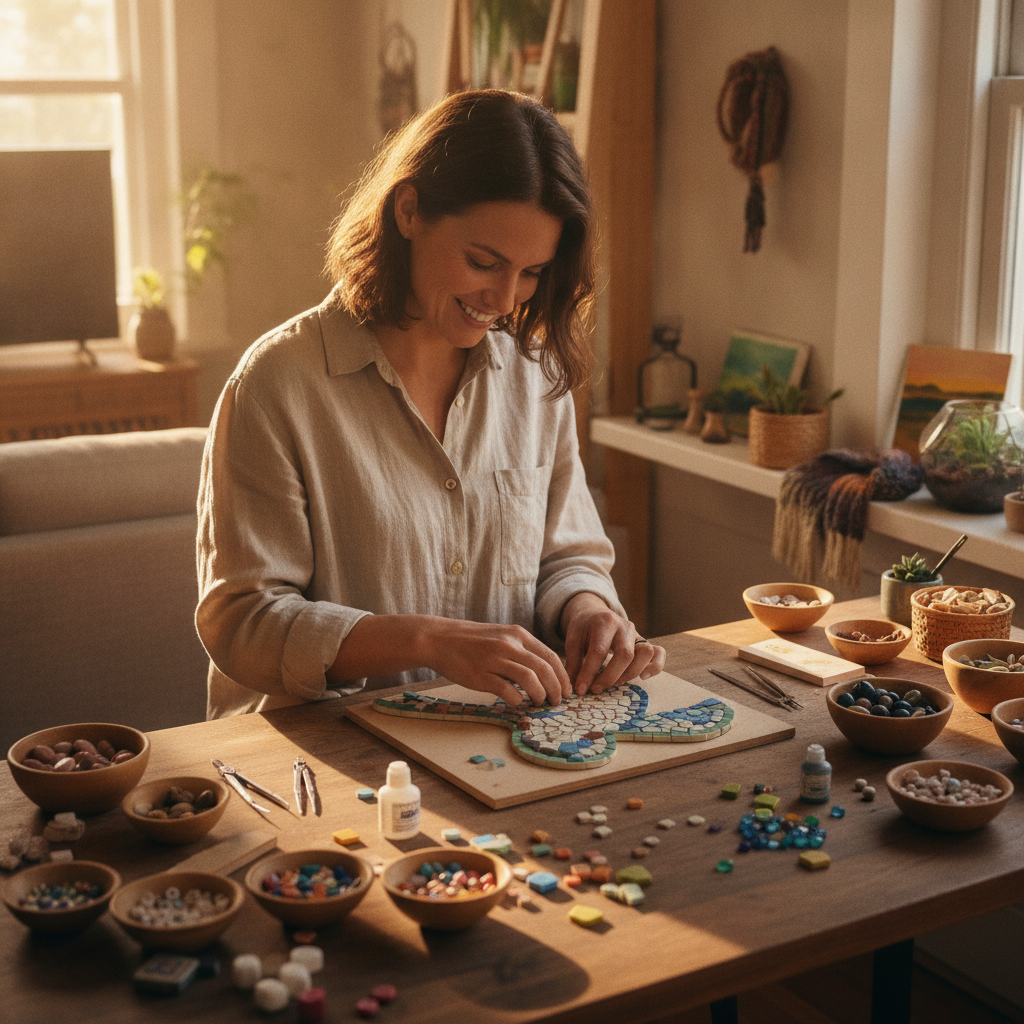
Unlimited free time has a way of collapsing into itself. The weekend stretches open, full of possibility, and somehow by Sunday evening very little has happened — not because nothing was available, but because too much was. This is one of the quieter paradoxes of modern leisure: the more open the hours, the more difficult it becomes to feel genuinely satisfied by what fills them. A growing number of people are discovering, often accidentally, that introducing a narrow creative constraint into their week — a single craft, a time limit, a specific material — produces something that endless availability rarely does: a feeling of having actually made something.
The Problem With Formless Free Time
Psychologists who study leisure have long observed that unstructured time is harder to enjoy than people expect it to be. Without a frame, attention drifts. The mind, accustomed to the shape of obligation, struggles to settle into genuine rest or genuine play. What results is often a restless half-engagement — scrolling through options on Netflix or Spotify, starting something and abandoning it, feeling vaguely dissatisfied without quite knowing why. This experience has a name borrowed from the Hungarian-American psychological tradition: *apathy drift*, the low-grade aimlessness that arrives when neither rest nor activity fully claims the hour. The problem isn't laziness. It's the absence of a containing structure that makes engagement possible in the first place.
Craft, in its most practical sense, offers exactly that structure. Whether it's a thirty-minute block set aside for lino printing, a Sunday afternoon dedicated to sourdough, or a Tuesday evening reserved for hand-lettering on index cards, the constraint itself becomes generative. Apps like Skillshare and Domestika have built entire communities around short, project-based creative sessions precisely because the limit — this material, this technique, this much time — frees the participant from the exhausting work of deciding what to do with an open hour. The decision is already made. What remains is only the making.
Why Constraints Unlock Creative Satisfaction
The relationship between limitation and creative fulfillment is well-documented across artistic traditions. Japanese *wabi-sabi*, the aesthetic philosophy that finds beauty in imperfection and incompleteness, is in part a framework for accepting constraint as a source of meaning rather than a barrier to it. When a ceramicist works within the logic of a single clay body, or a poet accepts the fourteen lines of a sonnet form, the limitation doesn't diminish expression — it focuses it. The same principle applies to the hobbyist who sets aside forty-five minutes on a Saturday to work only with watercolor on small paper. The smallness of the project is not a compromise. It is the condition that makes completion possible, and completion is precisely what produces the satisfaction that sprawling leisure so often withholds.
This is also why craft-based leisure tends to be more restorative than passive consumption, even when the passive option seems more appealing in the moment. The anticipatory pull of sitting down to watch something or browse something feels like ease, but it rarely delivers the particular satisfaction that comes from having produced a small, tangible thing. Makers' markets in cities like Portland and Austin are filled with people who started a craft practice not out of professional ambition but out of a need to feel the specific pleasure of finishing something with their hands. The object — however modest — functions as evidence. The hour had a shape. Something came out of it.
The Weekly Rhythm as a Holding Structure
What makes a weekly craft constraint particularly effective, rather than a daily one or a sporadic one, is the rhythm it creates. Weekly repetition is frequent enough to build genuine skill incrementally but spaced enough that the session carries a small sense of occasion. Monday through Friday carries its own demands; the designated creative window, arriving reliably on a particular evening or morning, becomes a landmark in the week rather than just another task. Over time, people who maintain this kind of rhythm report that they begin to look forward to the session in a way that diffuse leisure rarely produces — not with urgency, but with a quiet, specific anticipation. The constraint has become, paradoxically, one of the most freely chosen hours in the week.
Platforms like Ravelry, the knitting and fiber arts community, demonstrate this dynamic at scale. Members set small project goals — a single skein of yarn, a dishcloth, a hat — and return week after week, not because the projects are ambitious but because the regularity itself is satisfying. The forum threads are full of people describing their Wednesday evening knitting hour as the most genuinely restorative part of the week. They are not producing masterpieces. They are producing something completed, on schedule, within a container they chose. That combination, it turns out, is closer to what humans actually need from leisure than the formless abundance that technology now makes so easy to offer.
Choosing a Constraint That Fits the Life You Have
If you're considering building this kind of practice, the constraint should be specific enough to eliminate decision-making but flexible enough to remain genuinely yours. Choosing a single medium — block printing, embroidery, simple woodcarving — and committing to it for at least six weeks is usually enough time to feel the shift from awkward beginner friction to the easier flow of familiar process. The time block doesn't need to be long; forty-five minutes to an hour is often more sustainable than a full afternoon, and sustainability is what turns a good idea into a real practice. The goal is not mastery. It's the weekly return to a small, bounded world where the hour has a shape and the work, however modest, can be held in the hand when it's done.
There's something quietly corrective about this kind of practice in the context of contemporary life, which tends to prize scale, speed, and optionality above almost everything else. The small craft constraint asks for none of those things. It asks only for a return — same time, same materials, same patient attention to the thing being made. And it delivers, week after week, the particular satisfaction that open-ended leisure keeps promising but rarely manages to produce: the feeling, at the end of a designated hour, that the time had a purpose you gave it yourself.