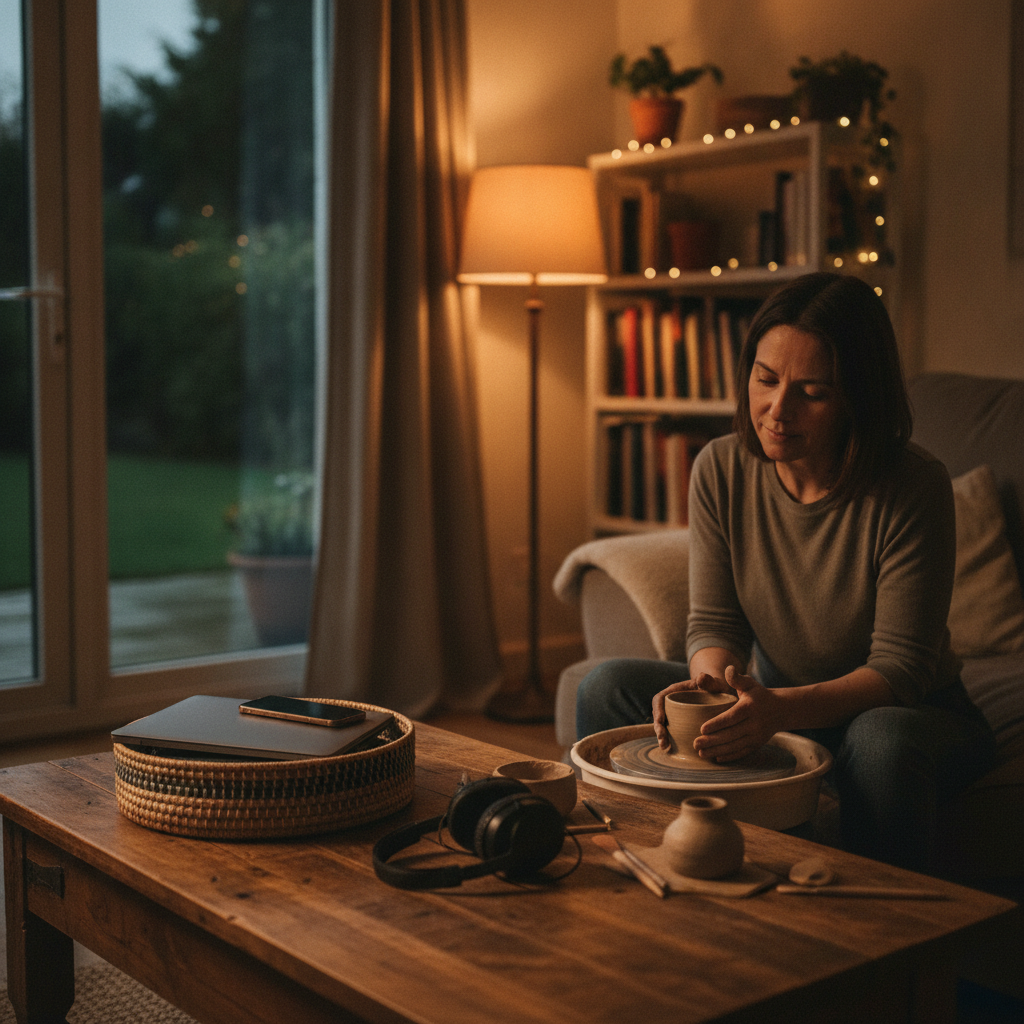
Most people arrive at the weekend already depleted, not from physical exhaustion, but from the slow accumulation of screen exposure that runs well into weekday evenings. You close your laptop, reach for your phone, scroll through something, maybe queue up a show — and before long, the line between work and recovery has blurred so thoroughly that your nervous system never quite gets the signal to stand down. Saturday morning arrives and you feel like you need to recover from recovering.
The fix isn't complicated, but it does require a firm commitment. When you set a hard cutoff — a specific time after which no screen-based tasks happen — and replace that window with something genuinely low in stimulation, the effect on weekend restfulness is both measurable and surprisingly fast.
Why Your Evenings Are Quietly Eroding Weekend Recovery
The brain doesn't switch off just because the workday technically ended. Screen-based tasks — whether that's reviewing emails, editing a document, browsing productivity tools, or even watching algorithmically driven content on YouTube — keep your cognitive arousal elevated for hours beyond the moment you stop. The issue isn't screens themselves so much as the type of processing they demand: reactive attention, decision-making, and the low-grade anticipation that comes from being perpetually available to incoming information. By the time Friday rolls around, you've spent five consecutive evenings in a mild state of alert readiness, and your weekend pays the price.
The Mechanics of a Hard Cutoff That Actually Holds
Choosing the Right Stop Time
A cutoff only works if it's specific. "Winding down around nine-ish" is not a cutoff — it's a wish. Pick a time that accounts for your real schedule, not your ideal one. For most people working standard hours, somewhere between 8:00 and 9:00 PM on weeknights gives enough runway to finish what's genuinely urgent without eating into recovery time. The key is that the time stays fixed regardless of what's pending. Urgency has a way of expanding to fill whatever space you give it, so the boundary has to be non-negotiable to function.
Using Technology to Enforce the Boundary
This is where a few specific tools become genuinely useful. Freedom (the app) lets you schedule recurring blocks that restrict access to specific sites and apps across all your devices simultaneously — which matters because willpower alone tends to erode by Tuesday. Apple's Screen Time and Android's Digital Wellbeing both offer downtime scheduling that can lock certain categories of apps after a set hour, including email clients and social platforms. If you use a dedicated work tool like Notion or Slack for task management, setting your notification schedule to go dark after your cutoff time is a small adjustment that makes a real difference. The goal isn't to use technology punitively — it's to remove the friction of deciding every evening whether tonight is an exception.
Replacing the Window, Not Just Emptying It
Why Passive Rest Isn't Enough
Simply stopping screen-based tasks doesn't automatically produce calm. For many people, the first instinct is to fill the cutoff window with something equally passive — lying on the couch, scrolling a different app, or flipping between streaming services on Netflix. The problem is that passive consumption without direction still keeps the brain in a receiving mode rather than a genuine rest state. What shifts things more effectively is a replacement activity that has a low ceiling of stimulation and a slow, self-paced rhythm.
Low-Stimulation Hobbies That Actually Work
The most effective replacements share a few qualities: they're tactile or analog, they have a visible, satisfying output, and they don't require you to make fast decisions or track new information. Things like sketching, jigsaw puzzles, hand lettering, basic woodworking, knitting, or tending houseplants tend to work well because they engage the hands and produce something tangible without demanding the kind of reactive attention that screens do. Reading physical books — particularly fiction — also fits this category, since the pace is controlled entirely by you and there's no algorithm pushing you toward the next thing. Even a short session of 30 to 45 minutes in this kind of activity, done consistently four or five evenings a week, begins to reshape how deeply you sleep and how genuinely rested you feel by Saturday morning.
What Consistent Practice Does to Your Weekends
The shift doesn't happen all at once. The first week, you might feel restless during the cutoff window, reaching for your phone out of habit and catching yourself mid-reach. That friction is useful information — it shows you how conditioned your evenings have become. By the second and third week, the replacement activity starts to feel like something you're actually drawn to rather than a substitution. And by the fourth week, most people notice something specific: they wake up on Saturday with a different quality of readiness. Not just rested, but genuinely available — to plans, to spontaneity, to people, to boredom in the good sense of the word.
The Longer Arc Worth Watching
As the relationship between screen time and cognitive recovery becomes better understood, more tools are being designed to support intentional boundaries rather than erode them. The trajectory points toward smarter defaults — devices that understand your patterns and offer friction-free ways to protect your downtime rather than compete for it. For now, the most powerful version of this system is still a human one: you decide the time, you choose the replacement, and you hold the line. The weekends that follow tend to speak for themselves. Start by picking your cutoff time tonight, and choose one low-stimulation activity to keep within reach when that hour arrives.