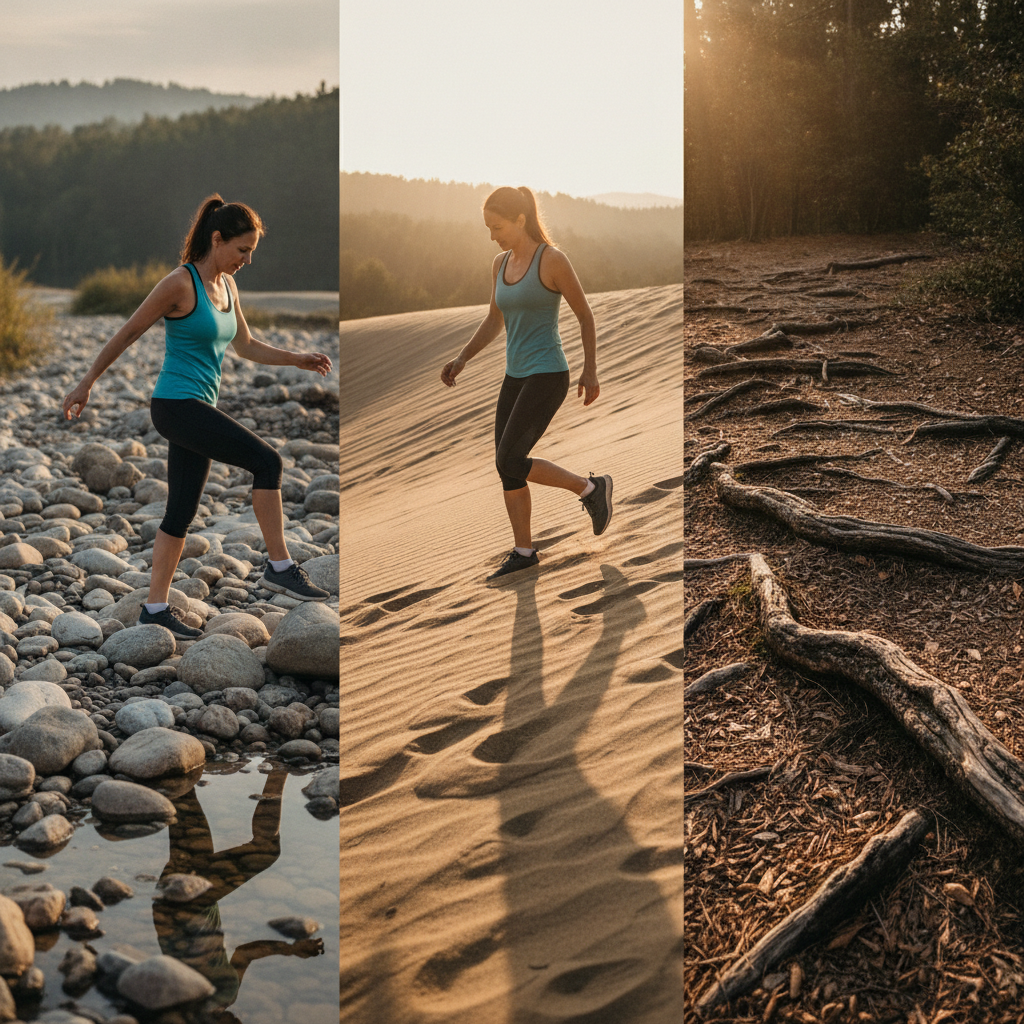
Walking on different surfaces engages the body in ways that speed alone cannot replicate. Most people who want to improve their fitness instinctively reach for the same lever — walk faster, walk longer — without considering that the ground beneath their feet may be the more powerful variable. Surface variation triggers distinct neuromuscular responses, challenges stabilizing muscles that flat terrain leaves dormant, and builds proprioceptive awareness that transfers directly into everyday coordination and injury resilience.
What Makes Surface Variation Physically Different From Speed?
Changing walking speed primarily alters cardiovascular demand and stride frequency. The muscles doing the work remain largely the same; they simply cycle through familiar movement patterns at a different rate. Surface variation, by contrast, changes the mechanical inputs arriving at the foot with every step. An uneven trail, a sandy beach, or a grassy slope forces the ankle, knee, and hip to make continuous micro-adjustments that flat pavement never demands. These adjustments recruit stabilizer muscles — particularly the peroneals, tibialis posterior, and hip abductors — that standard speed-based walking barely touches.
How Does the Body Respond to Unstable Ground?
When the foot lands on an unpredictable surface, the nervous system must process sensory information faster and more completely than it does on a smooth track. Mechanoreceptors in the feet, ankles, and lower legs send rapid signals upward, prompting reflexive corrections throughout the kinetic chain. This proprioceptive loop is the same system that prevents falls during sudden sidewalk cracks or icy patches. Training it through deliberate surface variation — grass, gravel, packed dirt, cobblestones like those found throughout Lisbon's Alfama district — essentially rehearses the body for the unpredictability of real life rather than the controlled environment of a treadmill.
Which Surfaces Produce Which Specific Adaptations?
Different surfaces stress different systems. Sand walking, particularly soft sand, dramatically increases calf and foot muscle activation and raises metabolic cost without requiring any change in pace. Grass and uneven trail surfaces like those common in REI-recommended hiking areas challenge ankle stability and encourage hip abductor engagement. Hard-packed gravel or cobblestone paths improve foot intrinsic muscle strength and ground contact sensitivity. Uphill grass slopes introduce posterior chain loading — glutes and hamstrings — that flat walking rarely achieves. Each surface type functions as a distinct training stimulus, and rotating through them accumulates adaptations across multiple muscle groups and neurological pathways simultaneously.
Why Do Balance Adaptations Require Irregular Input?
Balance is not a static ability; it's an active, trainable skill maintained by continuous feedback between the body and the environment. Flat surfaces provide so little variation in that feedback that the balance system essentially goes on autopilot. Irregular surfaces, by contrast, keep the cerebellum and vestibular system actively engaged throughout the walk. Over weeks of consistent surface variation, this produces measurable improvements in static and dynamic balance that speed-based training on predictable surfaces does not generate to the same degree. For older adults particularly, this distinction carries significant practical weight — better dynamic balance is one of the strongest predictors of fall prevention.
What Does This Mean for Functional Strength Outside the Gym?
The strength built through surface-varied walking is sometimes called functional strength because it develops within the context of real movement demands. Unlike isolated gym exercises, walking across a Patagonia trail or a neighborhood park with rolling terrain trains muscles in their actual working relationships — coordinating across joints, sharing load, responding to external unpredictability. The hip stabilizers, foot intrinsics, and ankle complexes that activate on uneven ground are precisely the muscles most implicated in knee tracking, lower back support, and postural stability during standing work or prolonged daily activity. Surface-varied walking builds this capacity in a highly transferable way.
How Can You Build Surface Variation Into a Regular Walking Habit?
The practical shift is smaller than it might seem. You don't need remote trails or specialized equipment to introduce surface variety. Start by identifying three distinct surfaces accessible within your normal movement range — a local park with a grass section, a neighborhood stretch of brick or pavers, and any gentle slope. Apps like AllTrails can help locate nearby unpaved paths even in urban areas. Alternate these surfaces across your weekly walks rather than defaulting to the same sidewalk loop. As your ankle stability and foot strength develop, introduce steeper inclines or softer ground. The goal isn't to abandon speed as a variable — it's to recognize that surface is an equally important dimension of walking that most routines leave almost entirely unexplored.
The conversation around walking as exercise is gradually expanding beyond step counts and pace metrics toward a more nuanced understanding of how movement quality and environmental variety shape long-term physical capacity. Wearable companies like Garmin and fitness platforms focused on outdoor movement are beginning to incorporate surface-type tracking and terrain data into their training recommendations. As that data becomes more widely available, surface-varied walking is likely to become a central feature of evidence-informed fitness guidance — not just for athletes, but for anyone seeking stronger, more adaptable movement well into later life.