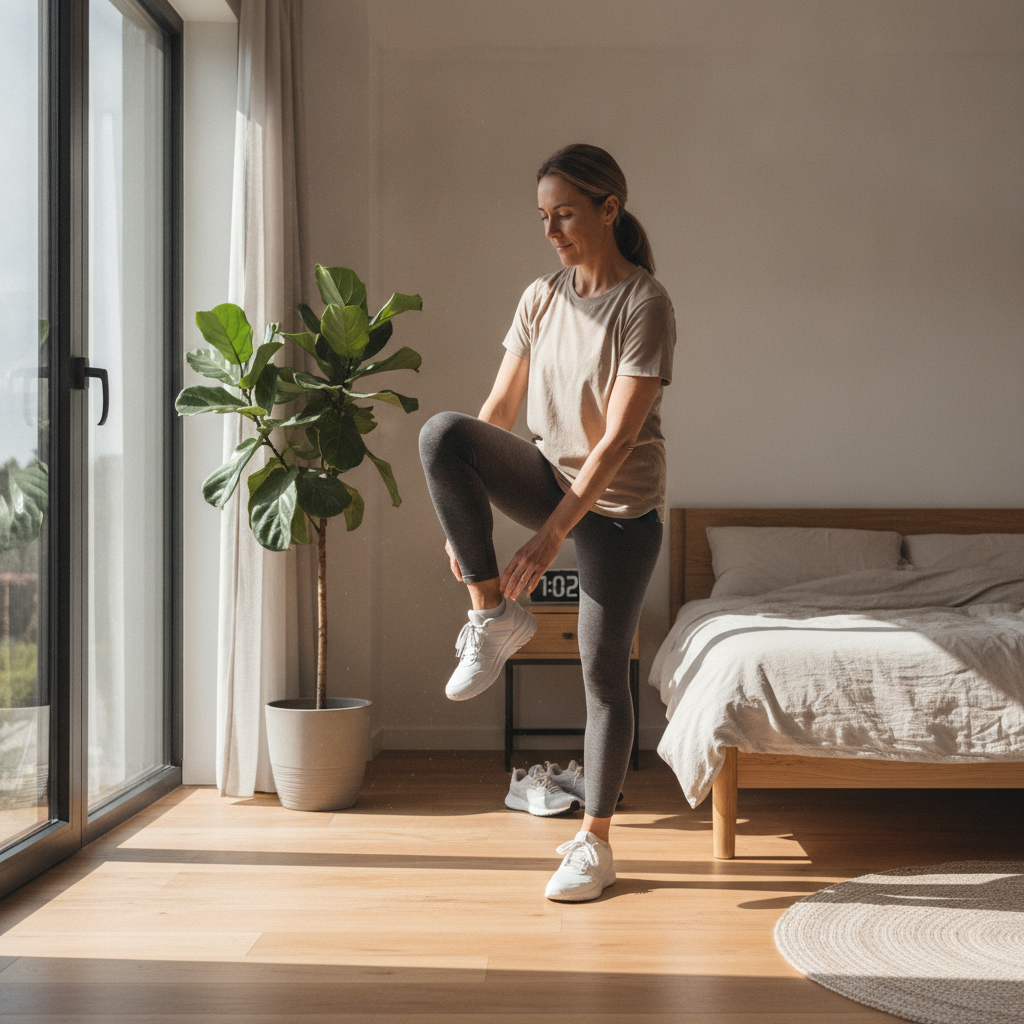
Balance strength quietly erodes long before most people notice it's gone. The muscles and neural pathways that keep you upright on uneven ground, stairs, or a slippery floor need regular, low-level challenges to stay sharp — and the good news is that the challenge doesn't have to be complicated or time-consuming. Attaching a two-minute balance exercise to something you already do every single day — putting on your shoes — gives those systems exactly the stimulus they need. No gym, no new schedule block, no willpower required.
Anchor the Habit to Something You Already Do
Behavior science consistently shows that new habits stick best when they're attached to existing ones. Putting on your shoes is a non-negotiable daily act, which makes it the perfect anchor. The moment you sit down to lace up, that's your cue. You don't need to remember a separate exercise time, set a reminder app, or carve out space in your calendar. The routine already exists — you're simply adding a two-minute layer on top of it. Apps like Habitica can help you track the streak early on if you want a little reinforcement, but honestly, the anchor itself does most of the work.
Start With a Single-Leg Stand While You Lace Up
The simplest version of this practice is also one of the most effective: stand on one foot while you put on and lace the other shoe. Hold a wall or chair if you need support at first — that's not cheating, that's smart progression. As your balance improves over days and weeks, reduce how much you touch the support surface. The single-leg stance directly trains the stabilizer muscles in your ankles, knees, and hips, along with the proprioceptive sensors that tell your brain where your body is in space. Those sensors dull with age, and this is one of the most direct ways to keep them calibrated.
Progress by Reducing Your Base of Support Gradually
Once standing on one foot feels reasonably stable, make it slightly harder rather than much harder. Try closing your eyes for a few seconds, which removes visual input and forces your body to rely more on proprioception. Or try standing on a folded yoga mat or a balance pad like those made by Airex, which creates a slightly unstable surface without being risky. These small progressions prevent the habit from plateauing without turning it into something complicated. The two-minute window stays fixed; the difficulty adjusts as your body adapts.
Use the Second Shoe for the Other Leg
This is the built-in symmetry that makes the shoe ritual so convenient — you have a natural two-act structure. One shoe goes on one foot, the other shoe goes on the other. That gives you roughly one minute of single-leg work per side, which adds up to meaningful cumulative training over a week. Asymmetry in balance strength between legs is actually one of the more common risk factors for falls, so the bilateral structure of this habit is not just convenient — it's strategically sound. Treat each shoe as its own drill, not a repetition of the same one.
Add Gentle Arm Movements to Increase Challenge
Once the basic stand feels easy, introduce slow arm movements while balancing. Reach one arm forward, out to the side, or overhead while holding the single-leg position. This mimics real-world scenarios where you're balancing and doing something else simultaneously — reaching for a shelf, turning to look behind you, carrying something. The dual-task element is important because most falls happen during exactly these kinds of combined movements, not during a clean, focused stand. Keeping the movements gentle and deliberate ensures the challenge stays productive rather than risky.
Track Progress With a Simple Time Count
You don't need a wearable or an app to measure improvement. Simply count how many seconds you can hold each single-leg position without touching support. When you start, ten seconds might feel challenging. Within a few weeks of daily practice, thirty to forty seconds becomes achievable for most adults. That concrete improvement is motivating and also clinically meaningful — research in physical therapy consistently identifies single-leg stance duration as a reliable marker of functional balance. Writing a quick note in a simple notebook or the notes app on your phone once a week gives you a clear picture of where you're headed.
Know When to Involve a Physical Therapist
If you experience dizziness, sharp joint pain, or notice that one side feels dramatically weaker than the other, those are signals worth discussing with a physical therapist or your primary care provider. Programs like those offered through the YMCA's Enhance Fitness classes or a certified personal trainer who specializes in older adults can supplement what you're building at home. The shoe-ritual practice is a maintenance and prevention tool, not a rehabilitation program. For most healthy adults, it's perfectly safe — but it's worth knowing where the appropriate boundary sits.
Be Consistent Rather Than Perfect
Two minutes every day beats twenty minutes three times a week for this type of neuromuscular training. The nervous system responds to frequent, low-level input rather than infrequent, intense sessions. If you miss a morning, simply pick it back up the next day. There's no streak to protect and no session to make up. The goal is to make balance training so woven into your daily routine that it stops feeling like exercise at all — it just becomes part of how you get dressed. That's when the real long-term benefit accumulates.
Building fall-prevention strength doesn't require a program overhaul or a gym membership. It requires showing up for two minutes every morning, attached to something you'd do anyway. The consistency compounds quietly over weeks and months, and the payoff — steadier footing, stronger stabilizers, sharper proprioception — is genuinely worth the almost-zero effort it takes to begin. Lace up tomorrow morning, lift one foot, and start from there.