There is a particular restlessness that comes from planning a trip entirely around landmarks. The itinerary fills quickly — museum at ten, cathedral by noon, famous viewpoint before the light changes — and yet, somehow, the days feel both overscheduled and strangely hollow. The traveler moves efficiently from one fixed point to the next, accumulating photographs but rarely accumulating presence. What gets lost in this model is the underlying rhythm of the place itself: the slow commerce, the seasonal produce, the way a neighborhood wakes up on a Wednesday versus how it breathes on a Saturday morning when the weekly market appears and everything reorganizes itself around it.
The Logic of Market-Centered Planning
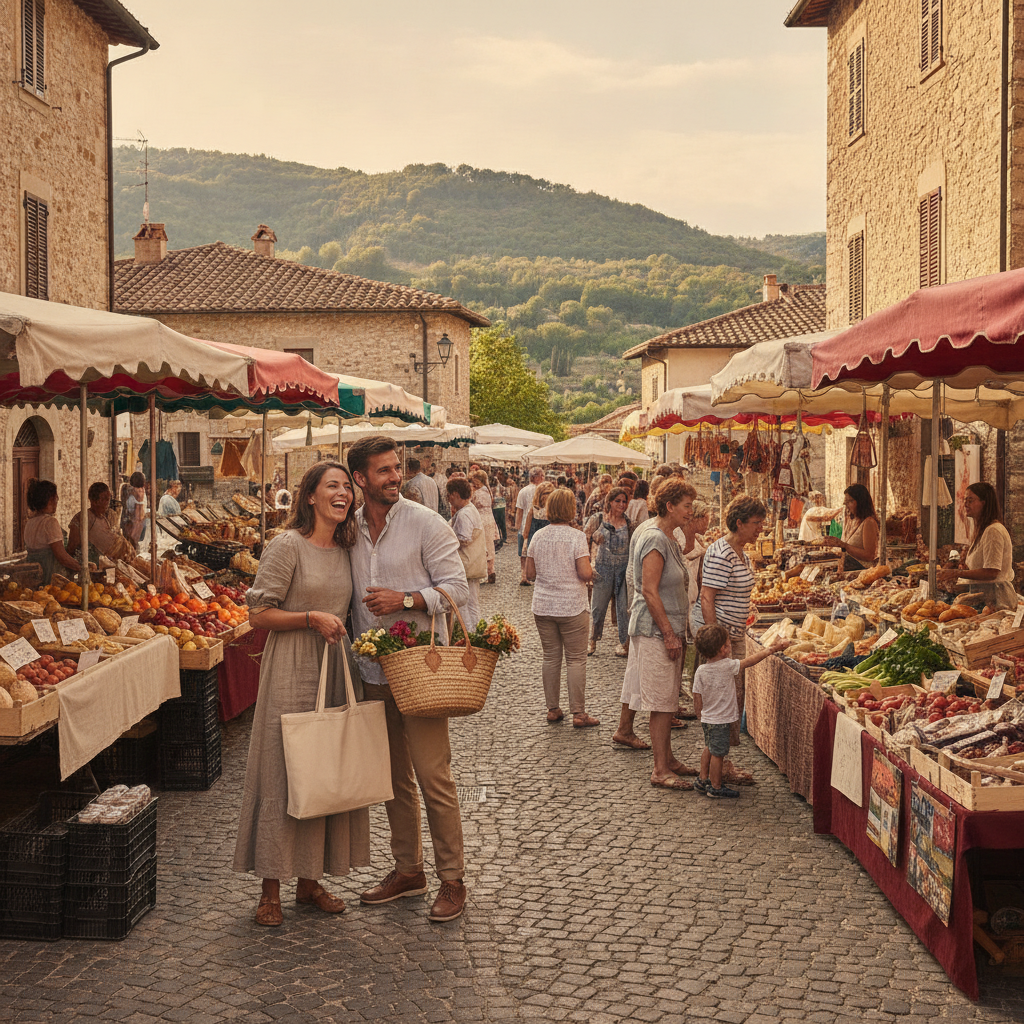
Outdoor markets operate on a logic that landmarks simply don't. A cathedral stands available every day at the same hour, largely indifferent to the season, the weather, or the local calendar. A weekly market, by contrast, arrives and disappears. It draws vendors from surrounding villages, farmers who loaded their trucks before dawn, artisans who have a regular stall and a regular clientele. In places like Provence, southern Spain, and rural Tuscany, the market isn't a tourist attraction layered onto the place — it is the week's social and economic spine. Planning around it means planning around something the locals themselves plan around, which is a fundamentally different orientation than chasing monuments.
This approach requires a small but meaningful shift in how a trip gets researched. Instead of beginning with a list of must-see sites and fitting everything else around them, the traveler starts by mapping which towns hold their markets on which days. In the Luberon region of France, for instance, villages like Apt, Lourmarin, and L'Isle-sur-la-Sorgue each hold their marchés on different days of the week, making it possible to build a nearly seamless circuit where the market is always the anchor and everything else — hiking, wine tasting, countryside drives — fills the quieter intervals between.
What Markets Reveal That Monuments Cannot
The outdoor market functions as something anthropologists call a *lieu de mémoire* — a site of memory — where the accumulated practices of a community become briefly visible. The particular cheeses a vendor carries reflect the surrounding terrain and dairy traditions. The way vendors address regulars, the accepted practice of tasting before buying, whether or not bargaining is appropriate — all of these are cultural texts written in behavior rather than in guidebook prose. A traveler who spends two hours moving slowly through the Mercado de San Telmo in Buenos Aires or the Sunday market in Chichicastenango, Guatemala, absorbs far more about local life than an afternoon at any museum could offer, because the information arrives through direct sensory encounter rather than curated interpretation.
Markets also impose a natural structure on the morning that benefits the entire day. Most outdoor markets are at their fullest and most vibrant between seven and eleven in the morning. This pulls the traveler out early — into the cooler air, the better light, the hour when the city belongs to its residents rather than its visitors. What follows organically is a long, unhurried midday: a lunch assembled from what was purchased, a slow afternoon with nowhere particular to be, an evening freed from the pressure to optimize. The landmark-focused itinerary rarely produces this quality of afternoon.
Building the Circuit Without Overengineering It
The practical architecture of a market-anchored trip is simpler than it sounds. Most regions with strong market traditions have their schedules documented through local tourism boards, regional food blogs, or apps like Roadtrippers, which allows custom itinerary building around points of interest the traveler defines. The key is to identify three to five market days within a region and work outward from each one, asking what is within reasonable distance and what would naturally fill the non-market hours. A market town on Thursday might be surrounded by a nature reserve worth a half-day walk on Wednesday, and a village known for its ceramics worth visiting Friday afternoon when the market crowds have cleared.
Accommodation decisions shift under this model as well. Staying in a single base — an apartment rental in a market town rather than a hotel in a tourist quarter — makes the most sense logistically and experientially. Returning to the same neighborhood across multiple days builds the kind of familiarity that makes a place feel briefly known rather than merely visited. The *fruttivendolo* — the produce vendor — who saw you at the stall Tuesday will recognize a face by Friday. That small continuity is something no landmark visit produces.
What You Actually Take Home
There is a difference between the memories a traveler carries home from a landmark itinerary and those that surface from a market-anchored one. The former tends to produce images: a famous façade, a famous view, a photograph taken from the famous spot marked on every map. The latter tends to produce scenes: the weight of a bunch of grapes handed across a counter, the smell of woodsmoke and roasting chestnuts on a cold morning in Alsace, a conversation conducted mostly in gesture because neither party shares a language. These memories are textured in a way that architectural photographs are not, and they tend to persist longer precisely because they engaged the body and not only the eye.
When you begin planning a trip with a market schedule rather than a monument checklist, something shifts in how the days unfold. The urgency that defines so much modern travel — the nagging sense that something important is being missed — quietly dissolves. The market arrives, and with it a ready-made reason to be exactly where you are, doing exactly what the locals are doing, at exactly the hour when a place is most fully itself. That restlessness described at the start — the hollow efficiency of moving between fixed points — has no room to take hold when the week already has its own shape, and you have simply chosen to follow it.