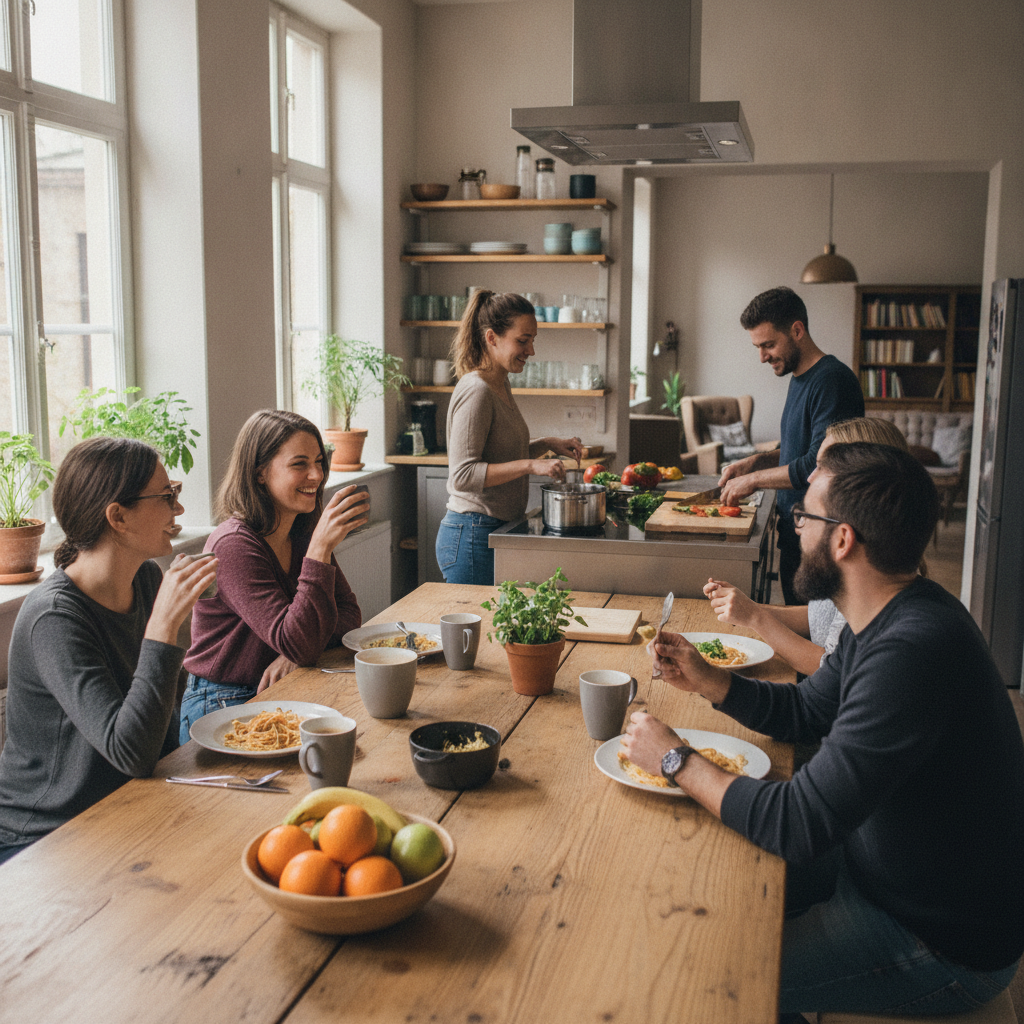
Travel has always been as much about the people encountered along the way as the places visited. The decision of where to sleep and how to eat while abroad carries consequences that reach far beyond comfort and convenience — it quietly determines the depth of human connection available during the entire journey. Choosing accommodation that centers a shared communal kitchen rather than the sealed privacy of room service is, at its core, a choice about the kind of traveler one wants to be and the kind of stories worth carrying home.
The Architecture of Accidental Encounter
There is something in the design of a shared kitchen that removes the formality travelers unconsciously carry into hotel lobbies and breakfast buffets. When two strangers are both searching for a saucepan at seven in the morning, the social script dissolves. The communal kitchen at properties like Generator Hostels in Copenhagen or Selina locations across Latin America functions less like a hotel amenity and more like a small village square — a space where proximity creates permission to speak. The architecture of these kitchens, with their open shelving, long communal tables, and mismatched mugs, signals that hierarchy has been suspended. Nobody is being served here; everyone is participating. That shift in posture, subtle as it is, fundamentally changes who speaks first and what gets said.
Room service, by contrast, delivers not just food but isolation. It is a beautifully efficient system for keeping people exactly where they already are, reinforcing the invisible boundary between paying guest and private space. The tray arrives, the door closes, and the evening continues in a sealed loop. There is nothing inherently wrong with this — rest is legitimate, and solitude has its own value — but the structural effect is that opportunities for unplanned exchange are engineered away. The communal kitchen does the opposite: it makes encounter the default rather than the exception.
What Shared Meals Unlock That Small Talk Cannot
Sociologists who study stranger interaction have long noted that shared tasks lower conversational barriers more effectively than shared spaces alone. Cooking together, or simply preparing meals in the same room, introduces what might be called *ubuntu* in the southern African philosophical tradition — a sense that one's humanity is expressed through relationship with others, not despite it. When a traveler from Osaka offers a pinch of dashi to someone from Lisbon who is making soup at the next burner, the conversation that follows rarely stays on surface topics. Food is deeply personal, and discussing it leads naturally into childhood memories, regional identity, family structure, and the quiet particulars of daily life that tourist attractions never reveal.
This is the quality of conversation that communal kitchens make possible — not polite exchanges about train schedules, but the kind of talk that leaves a person feeling genuinely known, even briefly. Accommodation like Clink Hostels in London or The Emblem in Prague are designed around exactly this social ecology. Their kitchens are not afterthoughts; they are the social spine of the building, and the conversations that happen around their counters carry a texture and warmth that no hotel bar has quite managed to replicate.
The Quiet Economics of Cooking Together
Beyond the social dimension, there is a practical logic to communal kitchen accommodation that tends to surface in conversation itself. Travelers who share kitchens often share ingredients, recommendations, and local knowledge in the same breath. Someone who has been in the city for three days naturally tells the newcomer which market sells the best produce, which neighborhood bakery opens at six, which street food stall the guesthouse owner actually eats at on weekends. This kind of information — what might be called *saber local*, a Latin American phrase loosely meaning insider local knowing — flows freely around a kitchen in a way it simply doesn't through a hotel concierge desk. The concierge offers curated suggestions shaped by partnerships and commissions; the fellow traveler at the cutting board offers whatever genuinely served them.
This exchange of practical wisdom has a compounding effect on the trip itself. Routes get adjusted, hidden neighborhoods get added to the itinerary, and the traveler begins to move through the city with a kind of confidence that only comes from having a small human network, however temporary. The communal kitchen is, in this sense, a remarkably efficient information ecosystem.
When You Choose the Kitchen, You Choose the Story
There comes a point in any long trip when the sights begin to blur together — the cathedrals, the viewpoints, the well-photographed squares. What tends to remain vivid, years later, is not a landmark but a moment: a late evening around a kitchen table in a hostel in Medellín, a spontaneous pasta dinner assembled from five different people's leftover groceries in a shared apartment in Bologna. These moments persist because they involved genuine exchange — the temporary collapse of the distance between strangers that most of daily life carefully maintains.
If you are planning a trip and weighing accommodation options, the presence or absence of a communal kitchen is worth treating as a serious filter rather than a minor amenity detail. Properties like Mad Monkey in Southeast Asia or the Wombat's City Hostel network across Europe have built entire communities around this principle, and their guests return not because the beds were exceptional but because the conversations were. Choosing the kitchen means choosing to remain open to the trip adjusting itself in ways that couldn't have been planned — and that openness, more than any itinerary, is what travel at its best has always offered.
Travel, at its most honest, is a practice in willingness — willingness to be uncomfortable, to be surprised, to be changed slightly by the encounter with unfamiliar lives. The communal kitchen is one of the few spaces in modern accommodation that still makes this kind of willingness structurally easy. It asks nothing more than showing up, and in return it offers something that room service, for all its efficiency, has never been able to deliver: the unscheduled, unrepeatable quality of a real conversation with a stranger who, by morning, no longer is one.