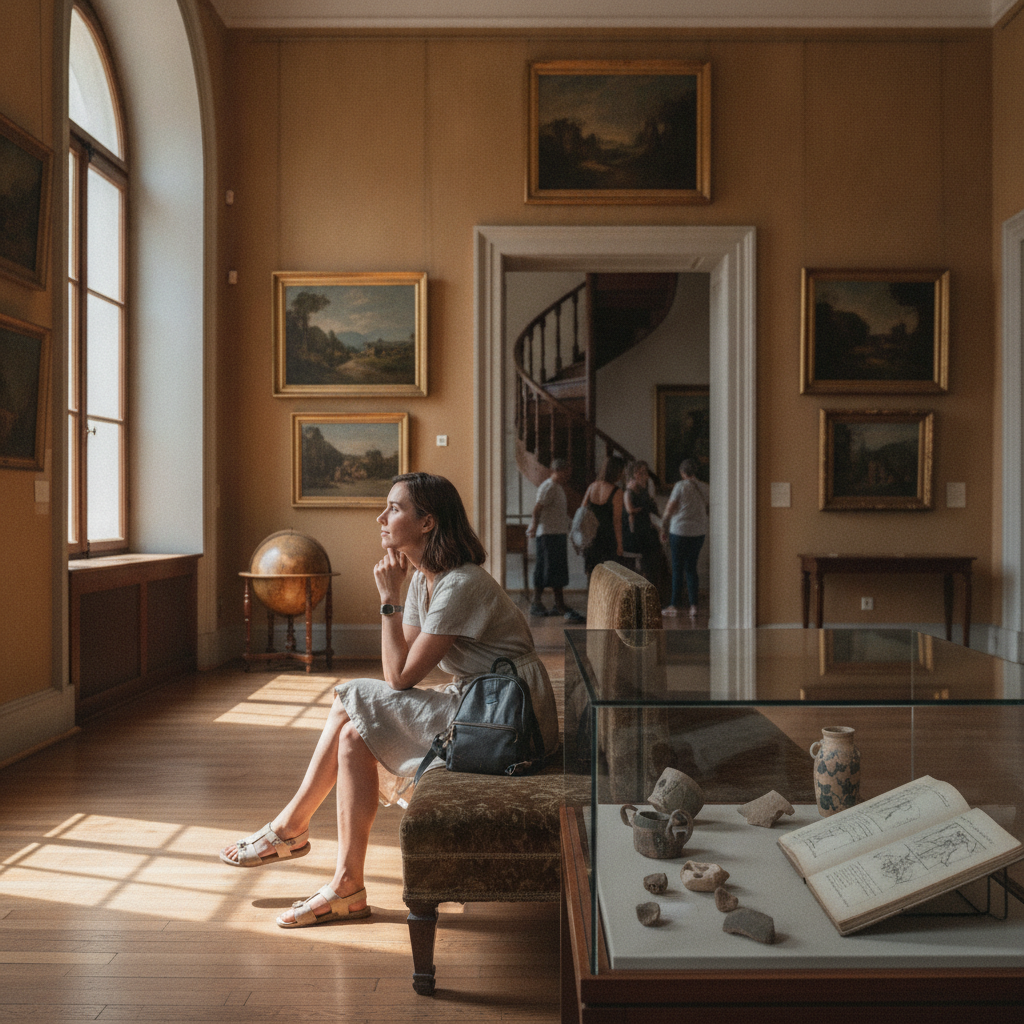
There is a particular kind of disappointment that arrives not as a sudden blow but as a slow, quiet deflation — the feeling that sets in somewhere between the third guided audio stop and the fourteenth photograph of a painting you've seen reproduced a thousand times before. The world's most celebrated museums carry an almost gravitational pull, and resisting them requires a specific kind of traveler confidence. Yet those who have spent years moving through unfamiliar cities often report the same counterintuitive truth: the rooms that stay with them longest were never the ones on the tourist map's front page.
The Weight of Expectation in Famous Institutions
Great museums are, almost by definition, victims of their own success. The Uffizi in Florence, the Rijksmuseum in Amsterdam, the Prado in Madrid — these institutions carry centuries of cultural prestige, and visitors arrive already weighted with expectation, mental images borrowed from textbooks, documentaries, and social media accounts dedicated entirely to their masterworks. That borrowed anticipation is not a neutral thing. It shapes perception before a single step is taken through the entrance, creating a kind of cognitive overlay that makes genuine encounter with the work itself surprisingly difficult. The traveler is often watching themselves having an experience rather than simply having one. The crowd, the queue, the audio guide's careful management of emotion — all of it conspires to produce something closer to a curated ceremony than an open-ended discovery.
What Smaller Institutions Actually Offer
The secondary museum — the municipal history collection, the small applied arts gallery tucked behind a cathedral square, the single-artist foundation preserved in its original building — operates under entirely different conditions. It tends to be quieter, less programmatically demanding, and far more permissive of the kind of slow, wandering attention that produces real engagement. The Museo Cerralbo in Madrid, for instance, receives a fraction of the Prado's daily visitors, yet its preserved aristocratic interior — objects arranged exactly as its owner left them in the nineteenth century — creates an atmosphere of intimate encounter impossible to replicate in a grand institutional hall. The work is no less serious; the context is simply more human in scale. A visitor can stand in a room for twenty minutes without being nudged forward, without the low pressure of a crowd forming behind them.
The Psychology of Low-Stakes Discovery
Memory research consistently points to a phenomenon sometimes called the *generation effect* — the finding that information or experiences we arrive at through our own effort are retained more durably than those delivered to us directly. The famous museum pre-delivers its meaning: the signage explains significance, the audio guide provides emotional context, and the institutional framing tells the visitor how to feel before they have a chance to decide for themselves. The smaller institution, by contrast, often lacks the resources for this level of curation. The visitor must generate their own interpretation, draw their own connections, and occasionally ask a staff member who actually knows the collection personally rather than reciting a script. That friction — mild, productive, and entirely voluntary — turns out to be the raw material of lasting memory.
Reading a City Through Its Overlooked Collections
A city's secondary museums are also, frequently, more honest indexes of what a place actually values and how it understands its own history. The Musée de la Chasse et de la Nature in Paris — a foundation-run space dedicated to hunting, nature, and the animal world, housed in a pair of seventeenth-century mansions in the Marais — tells a far stranger and more specific story about French cultural identity than any comprehensive national collection could. Regional textile museums, small naval history galleries, collections dedicated to a single craft or industrial era: these are the institutions that record what communities chose to preserve when no one was watching, which makes them unexpectedly revealing. They carry the texture of actual local life rather than the polished universalism of a museum designed to represent an entire civilization.
How to Find the Right Secondary Museum Before You Arrive
The logistical challenge is simply knowing where to look. National and regional tourism boards tend to promote their flagship institutions almost exclusively, which means the most interesting alternatives require some independent research. City government websites often maintain fuller cultural directories than tourism portals do. Apps like Culture Trip or even a destination's local-language Wikipedia page — run through a browser translation tool — frequently surface institutions that English-language travel coverage ignores entirely. A useful habit is searching for the city's name alongside terms like *fondazione*, *maison*, *sammlung*, or *casa museo* — the local equivalents of small foundation-run or house museum spaces that exist in almost every European city of any age. Asking accommodation hosts directly, particularly in locally owned apartments, reliably produces recommendations that no algorithm has yet learned to surface.
Giving Yourself Permission to Skip the Main Event
Perhaps the more interesting challenge is psychological rather than logistical. There is genuine social pressure attached to having visited the canonical institution — the conversation that begins with "and of course you went to the Louvre" carries an implicit assumption that any serious traveler would treat the famous stop as non-negotiable. Skipping it, or deferring it, or spending only an hour there before crossing the river to a smaller collection, feels like a mild act of cultural defiance. But travel that produces the most durable impressions tends to be travel that resists the predetermined script, not out of contrarianism, but out of a genuine preference for open-ended discovery over confirmed expectation. If you find yourself in a city with two or three days, consider spending one of them entirely in the category of institution that your planning process treated as secondary. The likelihood is that it will not feel secondary at all.
There is something fitting in the fact that the memory most travelers carry home from a trip is rarely the image they expected to carry. The painting reproduced on every postcard in the museum shop tends to flatten in recollection, crowded out by the logistics of having seen it. But the small room in an overlooked foundation — the one with the afternoon light coming through an old shutter and a guard reading quietly in the corner — has a way of remaining vivid long after the flagship experience has blurred into the general impression of having been somewhere important. That deflation at the famous museum is, in retrospect, a kind of invitation: a signal that the more genuine encounter is usually one street further, one decision quieter, and one expectation lighter than the one you arrived with.