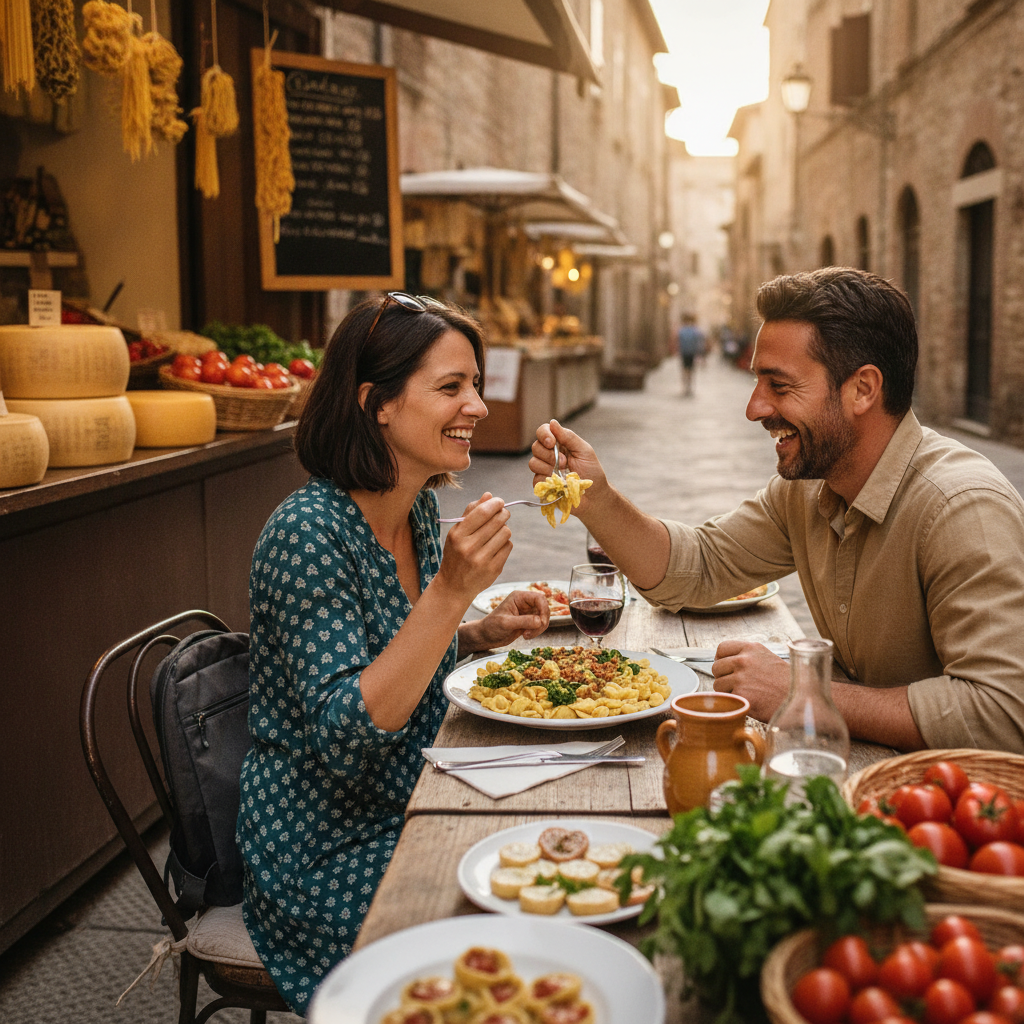
There is a particular kind of traveler who returns home not with a list of monuments visited but with a way of thinking about food that has quietly rearranged something in them. They didn't set out to collect experiences — they set out to understand one. The trip may have centered on a coastal fishing village in Galicia, or a hill town in Emilia-Romagna, or the night markets of Chiang Mai, but the through-line was always the same: a single regional food tradition that gave every other decision a kind of gravitational pull.
The Architecture of a Food-Centered Itinerary
Most itineraries are organized around geography — city to city, landmark to landmark — with meals slotted in between as logistical necessities. A food-centered itinerary inverts that structure entirely. The table becomes the anchor, and everything else — where to stay, how long to linger, which villages to visit — arranges itself around the culinary thread. This shift produces something unexpectedly practical: fewer decisions made in the abstract, and more made in response to what the food requires. If the tradition is mole negro from Oaxaca, the itinerary naturally includes the markets where dried chiles are sourced, the family kitchens that still grind by hand, and the mezcalerias where the meal finds its proper accompaniment.
Why Coherence Matters More Than Coverage
The instinct to cover as much ground as possible on a short trip is understandable, but it often produces a fragmented experience — beautiful in the moment, but difficult to hold together in memory afterward. When a food tradition serves as the organizing principle, the trip develops an internal logic that makes each day feel connected to the last. Eating *pintxos* in San Sebastián is enriching on its own, but understanding it as part of the Basque culture of communal bar-hopping, of txoko (private gastronomic societies), and of a regional pride that extends to how ingredients are sourced — that context transforms a pleasant snack into something that actually stays with a person.
The Practical Mechanics of Research and Routing
Building a food-centered trip requires a different kind of research than standard travel planning. Rather than consulting a city's top-ten sightseeing lists, the traveler begins with the food itself — its history, its regional variations, its producers and practitioners. Apps like Google Maps and platforms like Eater or Food52 offer starting points, but the more useful research often comes from forums, culinary travel blogs, and the websites of regional tourism boards that highlight agritourism routes. In Emilia-Romagna, for example, the Strada dei Vini e dei Sapori (Wine and Flavors Road) is a mapped route designed precisely for this kind of immersive, ingredient-led travel — connecting Parmigiano-Reggiano producers, prosciutto cellars, and family-run trattorias in a logical geographic arc.
How Food Traditions Open Doors to Cultural Depth
Regional food traditions are rarely just about flavor — they are compressed histories of a place, encoded in technique, ingredient, and ritual. The Oaxacan tradition of preparing *tlayudas* (large, crisped tortillas layered with beans, *tasajo*, and local cheese) reflects centuries of indigenous agricultural practice and trade. The slow-cooked *birria* of Jalisco carries the story of Spanish colonial-era cattle ranching meeting pre-Columbian cooking methods. When a traveler understands these layers, a meal becomes a form of reading — a way of encountering a culture's past and present simultaneously. This depth of context is almost impossible to achieve when food is treated as fuel between attractions rather than as the primary text.
Choosing the Right Tradition for the Right Traveler
Not every food tradition suits every traveler's interests or temperament, and that selectivity is part of what makes this approach rewarding. Someone drawn to fermentation and preservation might find a week in Copenhagen tracing New Nordic cuisine — from Noma's legacy to the smørrebrød (open-faced sandwich) culture of everyday Danish life — deeply satisfying. A traveler fascinated by spice complexity and layered heat might find Sichuan cuisine, with its concept of *mala* (numbing spice), a more alive and challenging focus. The key is choosing a tradition with enough regional breadth and cultural richness to sustain several days of exploration — one with producers, practitioners, markets, and living history, not just a single famous dish.
What Locals Notice When You're Actually Paying Attention
There is a social dimension to food-focused travel that often goes underacknowledged. When a traveler arrives at a small market stall or a regional trattoria with genuine curiosity about the food — asking how a sauce is built, or where a particular cheese is made — the interaction changes quality. Locals respond differently to people who are actually paying attention, and that difference opens conversations, invitations, and recommendations that no guidebook carries. In Chiang Mai's Warorot Market, a visitor who understands that *khao soi* (a coconut-curry noodle soup) is a northern Thai specialty distinct from the food of Bangkok will find that vendors are noticeably more willing to explain, to demonstrate, to share.
Letting the Food Tradition Guide the Pace of Return
Perhaps the most quietly transformative aspect of building a trip around a single food tradition is what it does to the traveler's relationship with time. When you are not trying to see everything, you stop experiencing the low-grade anxiety of missing something. Instead, you find yourself returning to the same market twice in three days, or sitting longer at a table than you planned, because the conversation moved somewhere interesting and the wine was from a producer you'd visited that morning. This is the kind of travel that generates not just photographs but actual understanding — a literacy about a place that persists long after the flight home. The traveler who left wanting to understand one thing returns having understood it, and that coherence is its own reward.
The person who builds a trip around a single food tradition rarely describes their travels as a list of sights. They describe them as a kind of education — one that was never didactic, never rushed, and that unfolded, meal by meal, in the way that real learning usually does. That quality of coherence, of one thing genuinely connecting to the next, is what transforms a trip from a series of impressions into something closer to an experience of actually having been somewhere.