Creative ambition has a quiet enemy, and it isn't laziness — it's invisibility. When a personal project lives only inside an app, it competes with dozens of other items in the same undifferentiated list, loses context every time the screen closes, and gradually fades from active memory into digital purgatory. The idea was real. The intention was genuine. But without a physical presence in the world, long-term projects have a way of becoming aspirations that never quite become actions.
Why Do Digital To-Do Lists Fail Long Projects?
Short-term tasks thrive in apps like Todoist or Notion. A grocery list, a meeting reminder, a bill payment — these items have clear deadlines and simple completion criteria. Long-term creative projects are structurally different. They require sustained context, evolving notes, and a kind of ambient awareness that flat task lists can't provide. When a project sits as a single line item in a digital queue, it carries no weight, no history, and no sense of progress. It becomes easy to scroll past, easy to reschedule, and eventually easy to forget without ever consciously deciding to abandon it.
What Makes a Physical Folder Functionally Different?
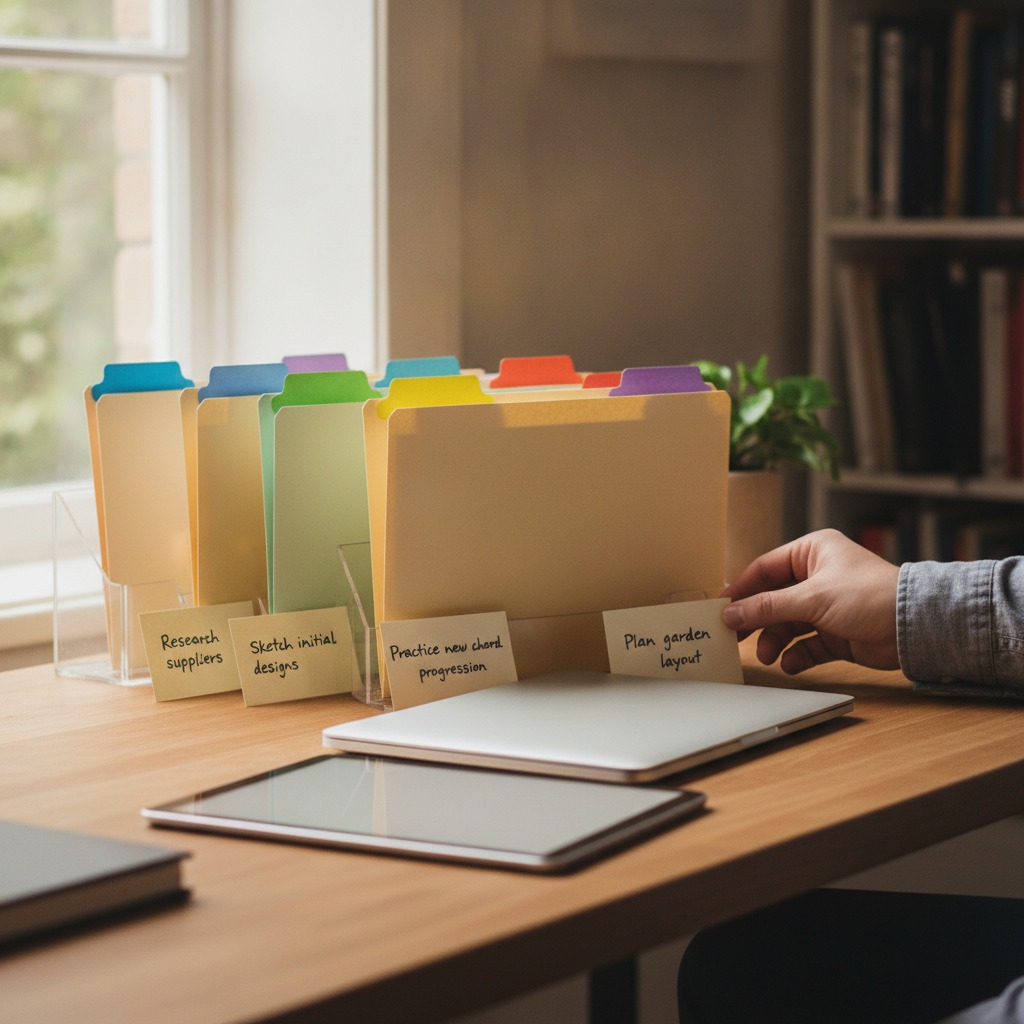
A dedicated physical folder — a plain manila folder, a labeled file from Muji or Leuchtturm1917, or even a repurposed binder pocket — creates what designers sometimes call an *object with gravity*. It takes up space. It can be moved, stacked, or left open on a desk as a passive reminder. Unlike a collapsed digital item, an open folder contains visible artifacts: sketched diagrams, printed references, handwritten notes from three months ago. This accumulated material gives a project texture and history that a single app entry simply cannot replicate. The folder becomes a miniature workspace rather than a placeholder.
How Does a Written Next-Action Card Change Behavior?
The key mechanism isn't the folder itself — it's the card inside. A next-action card is a single index card or small slip of paper placed on top of everything else in the folder. It contains one thing only: the specific, concrete next physical action required to move the project forward. Not "work on novel" but "write the opening paragraph of chapter three." Not "plan the podcast" but "draft five episode titles and choose one to outline." This specificity eliminates the cognitive gap between intention and action. When someone picks up the folder, they don't have to reconstruct their thinking from scratch — the card tells them exactly where to re-enter.
The written format matters, too. Handwriting a next-action forces a level of clarity that typing rarely demands. It's harder to be vague with a pen in hand and limited space on a card. That constraint is productive.
Why Does This System Work Especially for Creative Work?
Creative projects — a home recording, a illustrated journal, a short film script, a furniture restoration — don't follow linear paths. They pause, shift direction, wait on inspiration, and sometimes need months of background processing before the next meaningful step is obvious. A digital to-do list punishes this kind of rhythm because items that don't get checked off accumulate as visual guilt. A physical folder, by contrast, holds the project patiently without demanding immediate action. It simply exists, available when attention returns. Combined with an updated next-action card at the end of each working session, the folder becomes a reliable re-entry point after any gap, whether that gap is a week or three months.
This is particularly relevant for people juggling multiple creative interests simultaneously — a pattern that's increasingly common as side projects, learning pursuits, and personal creative work blend with everyday responsibilities.
How Should You Build and Maintain This System?
Start by identifying every long-term personal project currently living in your digital lists or your head. Give each one its own physical folder. Label the outside clearly, and write a current next-action card to place inside before you close it. Store the folders somewhere genuinely visible — a desktop file holder, an open shelf, or a simple tray. The system collapses if the folders migrate to a drawer.
When you finish a working session on any project, update the card before you close the folder. This ten-second habit is the entire maintenance cost of the system. Apps like Things 3 or Apple Reminders can still handle your daily task management — the physical folders aren't a replacement for digital tools but a companion layer for the work that needs more care than a checklist can offer.
Review all active folders once a week, even briefly. If a folder hasn't been opened in more than a month, the next-action card may need to be rewritten to reflect a simpler, lower-barrier entry point.
What This System Reveals About Attention and Priority
One underappreciated benefit of the physical folder method is diagnostic. When a project's folder sits untouched for an extended period despite an updated next-action card, that's useful information. It may signal that the project isn't genuinely a priority right now, or that the next action is still too large. Neither insight is available from a buried app entry. The physical system makes the status of each project legible in a way that a scrollable list never quite manages. A stack of five folders on a desk tells a story about a person's creative life at a glance — which projects are active, which are resting, and which may quietly need to be retired with intention rather than neglect.
Personal projects deserve more than a line in a queue. A folder and a card cost almost nothing, occupy almost no space, and return something that digital systems consistently struggle to provide: the feeling that the work is real, present, and genuinely waiting for you.