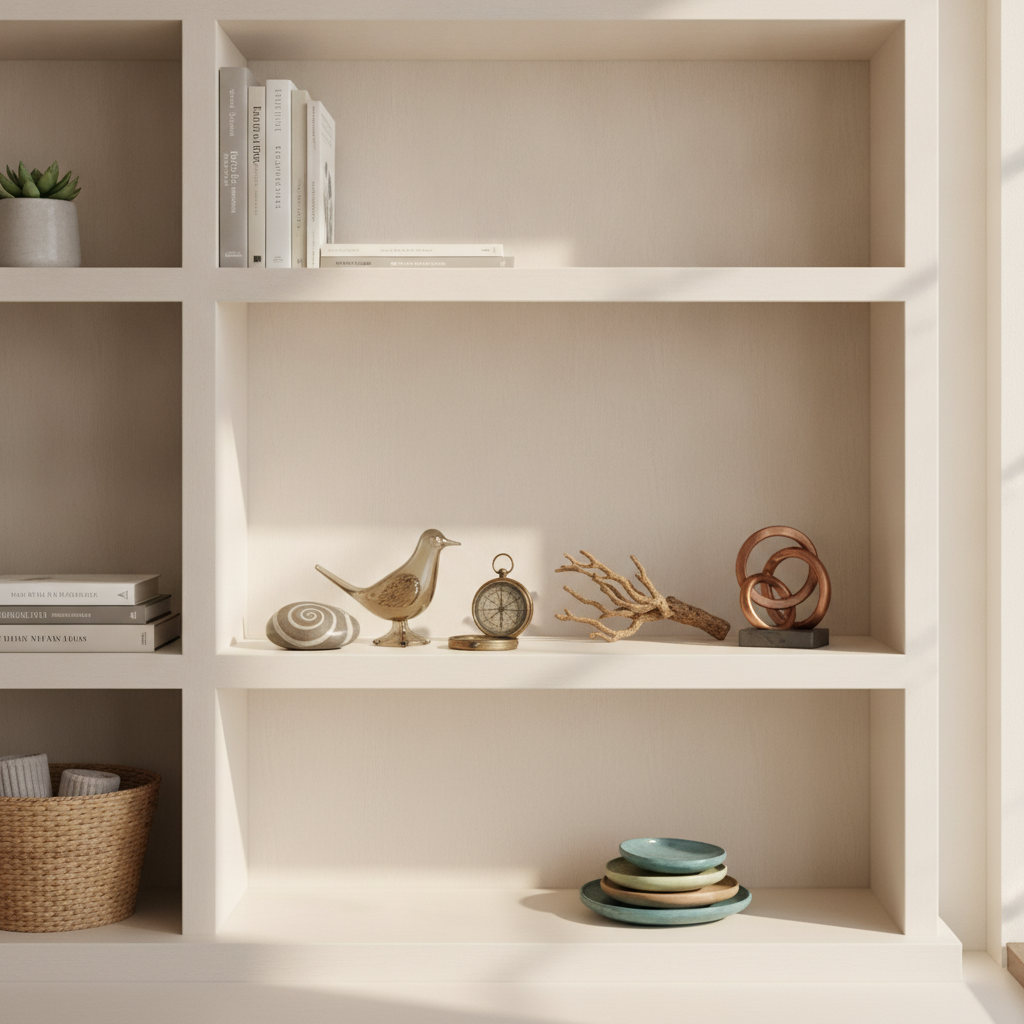
Every home tells a story about what its inhabitants believe they deserve. Most of that story is written in the language of utility — the charging stations, the storage bins, the kitchen tools organized by frequency of use. But there is a quieter, more revealing chapter written in the objects a person keeps for no reason other than that they matter, and the spaces those objects are allowed to inhabit.
What Does It Mean to Own Something Useless?
The word *useless* carries a cultural weight that tends to flatten its meaning. In most modern homes, objects justify their presence through function — they store, they organize, they facilitate. Yet across design traditions as different as Japanese *mono no aware* (the bittersweet awareness of impermanence, often expressed through objects) and the curated *Wunderkammern* of Renaissance Europe — those early cabinet rooms filled with curiosities valued for wonder alone — there has always been a parallel argument: that some things earn their place precisely because they do nothing except exist beautifully. A shelf dedicated entirely to such objects isn't clutter. It's a considered act of philosophical positioning about what a home is actually for.
How a Useless Object Shelf Shifts the Atmosphere of a Room
Designers who work with residential interiors in cities like Copenhagen and Kyoto have long observed that rooms feel different when they contain at least one zone of pure visual rest — a place the eye can land without being asked to process function. A shelf of non-utilitarian objects creates exactly this kind of pause. It interrupts the productive rhythm of a room without disrupting it, the way a rest in music creates tension and resolution. The shells, the ceramic figures, the inherited glass paperweight that does nothing but refract afternoon light — these objects absorb a kind of ambient meaning over time, accumulating the warmth of being chosen for reasons that can't be fully explained.
Why the Brain Responds Differently to Decorative Versus Functional Spaces
There is something cognitively distinct about a space that makes no demands. Functional objects prompt micro-decisions — where does this go, have I used this recently, does this still belong here. Non-functional objects, by contrast, ask nothing. They exist in a register closer to art than to inventory. Neuroscientists studying environmental psychology have noted that spaces with dedicated aesthetic zones — rooms where some area is clearly organized around beauty rather than productivity — tend to support lower baseline arousal and greater reported ease. The IKEA-saturated apartment and the Muji-organized desk have genuine virtues, but they can also create a subtle pressure in which every surface seems to be waiting to be optimized.
What Kinds of Objects Belong on This Shelf
The most effective non-functional shelves tend to resist curation anxiety — the impulse to make everything coordinate perfectly. The objects that work best are those that carry personal resonance rather than aesthetic credentials: a river stone collected in Portugal, a tiny brass elephant from a grandmother's bureau, a ceramic piece from a local studio in the Marais district of Paris that caught the light in a particular way. The shelf isn't a display case in the museum sense; it's closer to what the French call a *nature morte* — a still life — assembled not for viewers but for the person who lives with it daily. The objects can be mismatched, slightly odd, even humble. What matters is that none of them are there to be used.
How This Practice Connects to Broader Traditions of Intentional Living
The idea of reserving space for the non-functional has deep roots in traditions of intentional living that predate minimalism by centuries. In Japanese aesthetics, the concept of *ma* — negative space, the deliberate pause between things — is considered as structurally important as the objects themselves. In Scandinavian home culture, the tradition of *hyggekrog* (a cozy corner designed for comfort and atmosphere rather than productivity) reflects a similar instinct. Even the altar traditions found across West African, Mexican, and Southeast Asian domestic cultures point to the same recognition: that a home needs at least one space that operates outside the economy of usefulness, a place where meaning accumulates without being assigned.
How to Start Without Overthinking the Process
The practical entry point is simpler than it sounds. Choose one shelf — a single row in a bookcase, a floating shelf in a hallway, a windowsill that currently holds nothing. Clear it entirely. Then, over the course of a week or two, place only objects on it that serve no function and that you find yourself drawn to for reasons you can't immediately articulate. Resist the impulse to shop for new things. The most effective versions of this shelf are assembled from objects already in the home — the ones currently tucked into drawers because they don't fit anywhere logical. Apps like Curated Home and platforms like Etsy can supplement, but the starting material is usually already there, waiting to be recognized.
What Changes Once the Shelf Has Been Living With You
Something shifts, and it takes a few weeks to name it clearly. The room begins to feel inhabited in a different register — less like a system and more like a place. Visitors often comment on a single object from the shelf without being able to say why it caught their attention. The person who lives there starts to feel a subtle but genuine sense of being known by their own space, which is perhaps the most accurate description of what a home is supposed to do. The objects don't add meaning to a room so much as they create the conditions in which meaning can accumulate — the way silence doesn't add to music but makes it possible.
That observation, that homes tell stories about what their inhabitants believe they deserve, returns here with greater clarity. A shelf of purposeless, chosen objects is an argument — quiet and daily — that beauty and resonance deserve room alongside function. It doesn't require renovation or expense. It requires only the decision that some things are worth keeping precisely because they cannot be used.