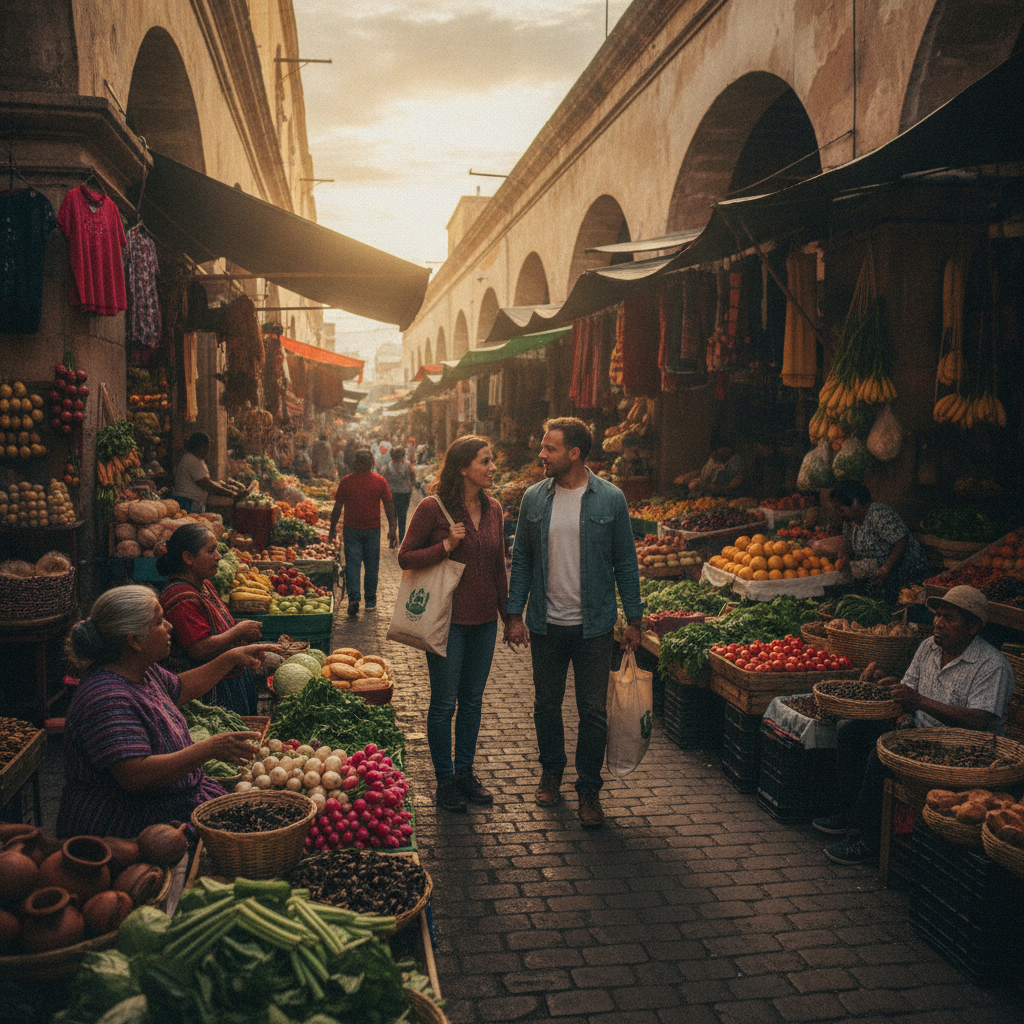
The way a traveler spends their first conscious morning in a new place quietly determines almost everything they will notice afterward. Not the grand monument photographed from every angle, not the famous viewpoint ticked off before breakfast — but the texture of ordinary commerce, the rhythm of exchange, the particular smell of a city before it has fully woken up. Choosing a destination's oldest functioning market as that first stop isn't a contrarian gesture. It's a calibration. And its effects carry through the rest of the trip in ways that are difficult to explain until experienced.
What a Market Actually Teaches That a Monument Cannot
Landmarks communicate a city's aspirations and its history of power. Markets communicate something closer to its metabolism. In the stalls of Istanbul's Kadıköy Pazarı or the interior of Bologna's Mercato di Mezzo, the visible logic of a local economy becomes readable — what is grown nearby, what is considered a luxury, what is eaten daily versus saved for celebration. These signals are not available on a placard or in a guided tour. They exist in the proportion of fish to produce, the price markers written by hand, the regulars who arrive at the same hour carrying the same bags.
The Sensory Anchoring Effect on Later Observation
There is a phenomenon in perceptual psychology sometimes described as priming — the idea that early exposure shapes what the mind registers as significant later. A traveler who begins at a market absorbs a concentrated sensory vocabulary: the weight of a specific citrus, the dialect of bargaining, the visual grammar of how vendors arrange their goods. For the remainder of the trip, that vocabulary operates as a reference frame. A restaurant menu becomes legible in a new way. A neighborhood's character reads differently when you recognize what it does and doesn't stock.
How Age Adds a Layer That Newer Venues Cannot
The oldest functioning market in most cities has survived not by accident but through genuine embeddedness in local life. Barcelona's Mercat de Sant Josep de la Boqueria traces its formal origins to the thirteenth century. Marrakech's central souks — the word souk (سوق) simply means market in Arabic — have operated in recognizable form for centuries, organized by trade into distinct quarters for spice merchants, leather workers, and metalworkers. That continuity is architecturally and socially legible. Walking through a space that has outlasted every political shift and urban redevelopment in a city produces a particular quality of attention that newer spaces, however photogenic, rarely generate.
The Social Contract Visible at Market Level
Markets are one of the few public spaces where genuine negotiation between strangers is still normalized in many cultures. In Japan, this takes a different form — the precision and ceremony of a fish auction at Toyosu Market, or the quiet efficiency of a neighborhood shotengai (商店街, a covered shopping street with deep community roots) — but the underlying social contract is still visible. Who greets whom first. Whether eye contact is invited or avoided. How complaints are handled and how generosity is displayed. These micro-observations accumulate into an intuitive map of social norms that no cultural briefing document fully replicates.
How the Market Recalibrates the Rest of the Itinerary
Travelers who begin at the market frequently report that their afternoon plans shift without deliberate intention. A vendor's offhand comment about a neighborhood becomes a route. An unfamiliar ingredient purchased on impulse becomes a reason to find a kitchen. A lane discovered while navigating between stalls becomes the most remembered street of the trip. The market functions less as a destination and more as a generator of subsequent destinations — a kind of analog algorithm that personalizes an itinerary around what the city itself seems to be offering rather than what a list of top attractions has prescribed.
The Difference Between Observation and Immersion
Most travel involves more observation than immersion — a visitor watches a city rather than participating in it. The market is one of the few spaces where participation is structurally required. A transaction, however small, is an exchange rather than a viewing. Pointing at an unfamiliar cheese and attempting its name in the local language is an act of presence that no museum visit quite replicates. This distinction matters because immersive moments tend to generate stronger and more specific memories. A traveler who spent twenty minutes at a stall in Oaxaca's Mercado Benito Juárez learning to identify different varieties of dried chili is unlikely to forget that morning, or the market, or what it taught them to see.
Arriving as a Witness to the City's Actual Day
When you choose the market as your first stop, you arrive into the city's real morning rather than its tourist-facing version. The vendors are already mid-conversation with each other. The produce has already been sorted and laid out. The regulars have already passed through once. You are, for the duration of that hour, a minor character in a scene that would have existed without you — and that distinction shifts something in how the rest of the day feels. The city stops being a backdrop and starts being an ongoing event. Every detail that follows — the font on a shopfront, the route a delivery bike takes, the timing of a church bell — carries more weight because the market has already established that this place has its own rhythms, running quietly and continuously, indifferent to the itineraries of visitors.
The oldest market in a destination holds that quality in concentrated form. It was there before the famous landmark was built, before the neighborhood around it changed names, before the city became a destination at all. Spending the first hour of the first morning inside it doesn't guarantee a better trip in any measurable sense. But it almost always guarantees a more specific one — more rooted in what the place actually is rather than what it has learned to show.