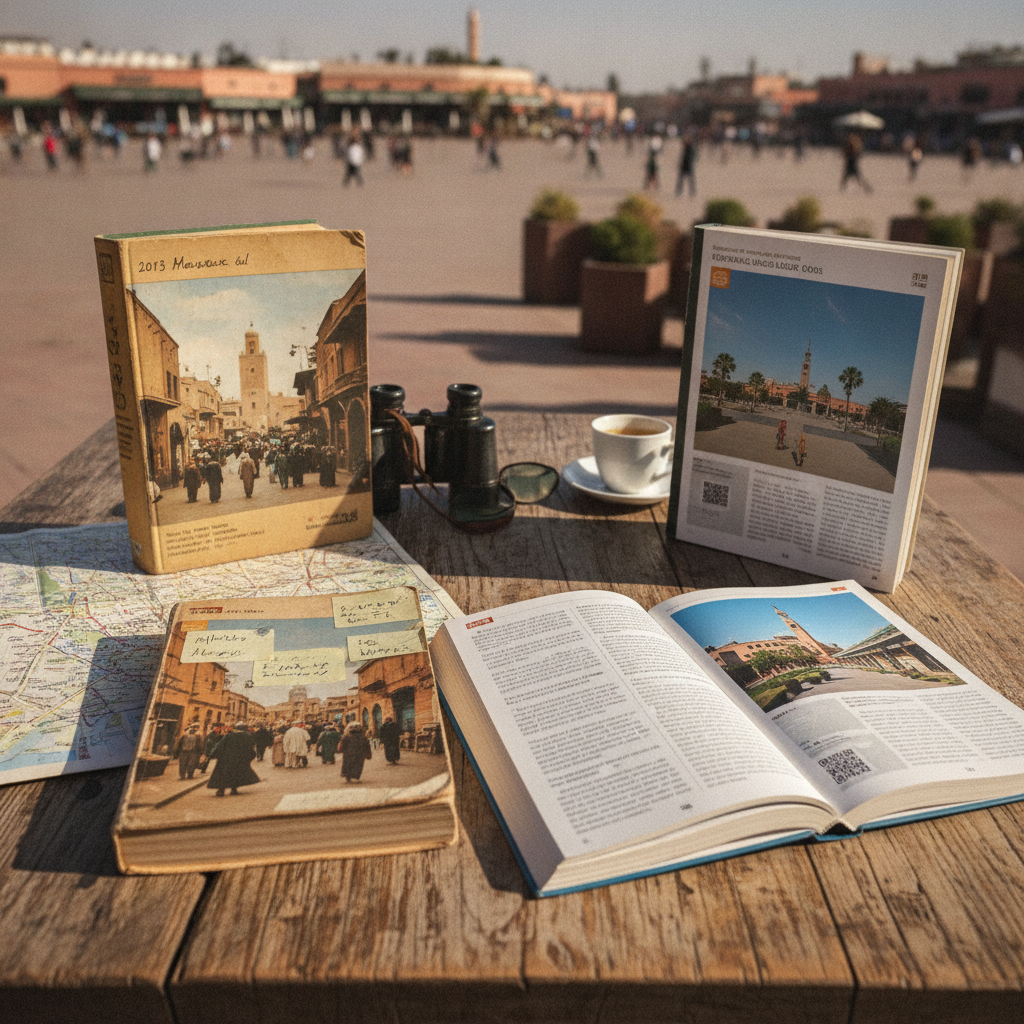
Travel carries a particular kind of optimism — the belief that a place holds something worth discovering. But a destination is never static. Neighborhoods shift, currencies fluctuate, beloved restaurants quietly close, and what was once a hidden courtyard becomes a background for a thousand identical photographs. Most travelers arrive with a single current guide and a fresh set of expectations, which means they experience only the present tense of a city. The traveler who packs two guidebooks — one current, one from a decade or more ago — arrives with something richer: a before-and-after lens that turns ordinary observation into genuine understanding.
What the Older Guidebook Actually Tells You
A guidebook from ten or twelve years ago is not a relic. It's a document of collective expectation — what travelers once valued, what residents were proud to share, and what felt worth preserving in print. When a 2013 edition of a Lonely Planet guide to Lisbon describes the Mouraria district as gritty, undervisited, and authentically local, and today's equivalent describes the same streets as a curated cultural quarter with wine bars and heritage tours, the contrast isn't incidental. It captures the full arc of gentrification in a few sentences. That kind of compression is extraordinarily useful for anyone trying to understand a city rather than simply pass through it.
The older guide also tends to describe things with different language. Neighborhoods that are now considered desirable were often described in cautious terms — as transitional, as working-class, as areas for adventurous travelers only. Reading those phrases today, standing in the middle of a polished square in what was once a port district, produces a specific and clarifying kind of cognitive dissonance.
Reading the Gaps Between Editions
The most revealing exercise isn't comparing what has changed — it's noting what has disappeared entirely. A restaurant mentioned warmly in an older guide, now absent from the current one, may have closed, or it may simply have fallen out of fashion with the demographic guidebook publishers now court. A neighborhood that once warranted several pages of detail might appear only as a footnote in the newer edition, which usually signals one of two things: the area has become so mainstream it requires no special guidance, or it has been quietly deprioritized in favor of trendier zones.
Cultural terms often shift too. What an older guide might have called a *mercado* — a traditional covered market where locals shop for daily provisions — a current guide may now describe as a *mercado gastronómico*, a curated food hall aimed squarely at tourists. The word is the same; the reality is entirely different. These semantic slips, easy to miss when reading only a single edition, become visible the moment you hold both books side by side.
Some disappearances are more poignant. In older guides to cities like Istanbul or Oaxaca, certain craft traditions are described in the present tense — weavers working in specific neighborhoods, ceramicists whose families have occupied the same workshop for generations. In current editions, the same crafts are often described historically, or as tourist experiences rather than living practices. That shift in tense matters. It marks the quiet extinction of something that once simply existed as part of ordinary life.
How the Comparison Changes the Experience on the Ground
Traveling with both books shifts the quality of attention. Rather than moving through a city as a passive consumer of what's currently recommended, you begin looking for evidence of what the older guide described — and finding it, or failing to find it, becomes its own kind of exploration. In Havana, you might carry a guide from 2012 that describes a particular street as the city's informal music corridor and another from 2024 noting the same street is now mostly empty of musicians. Standing there yourself, you're not just a tourist in a location; you're a witness to a specific transformation.
This is what travel writers sometimes call *palimpsest reading* — the practice of reading a place as a layered text, where older inscriptions show through beneath the current surface. Cities are genuinely palimpsestic in this way. A Barcelona neighborhood that the older guide called the working-class heart of the city and the current one calls the creative district hasn't simply changed names; it has undergone a social rewriting that affects real people's lives. Arriving with both books makes that rewriting legible.
A Different Kind of Souvenir to Bring Home
When you travel this way — with a decade's worth of perspective packed between two covers — you return with something that single-edition travelers often miss: a calibrated sense of how quickly places transform and how much of what feels timeless is actually contingent. The narrow street that felt ancient and unchanged was, according to the older guide, under renovation in 2014. The wine bar with the exposed stone walls that seems to have existed forever opened between editions.
Before your next trip, consider sourcing an older edition of a guidebook to your destination — used bookstores, online resellers, and library sales are reliable places to find them. Read both before you go, and carry them both while you're there. Mark the restaurants that appear in one but not the other. Find the neighborhoods described differently. Let the friction between the two versions become a compass. What you'll discover isn't just how a place has changed — it's how much of what we call travel is actually an encounter with time.
There's a particular satisfaction in returning home from a trip with that kind of understanding. Not the satisfaction of a checklist completed, but the quieter pleasure of having actually read the city — the way a careful reader reads a book, attentive to what's said and equally attentive to what isn't said anymore.