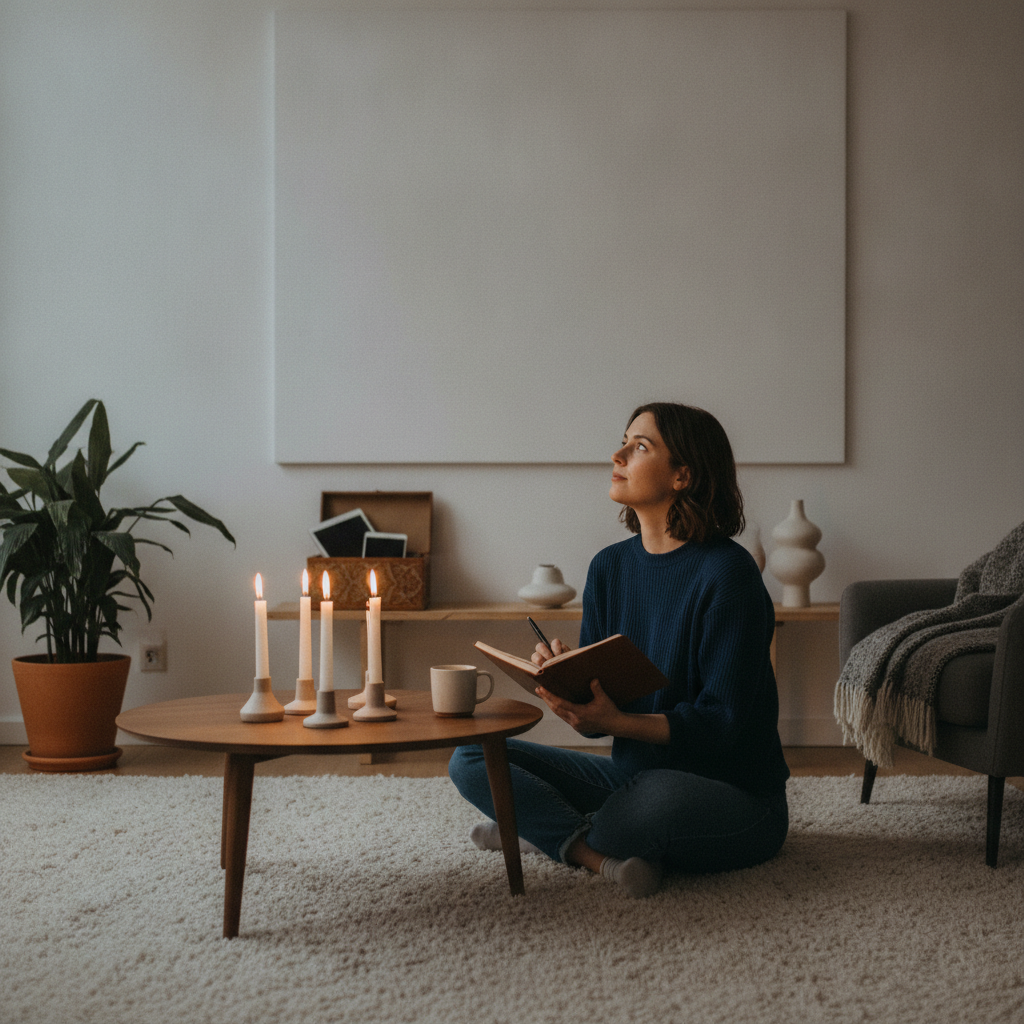
The mind, left without interruption, begins to think for itself. This observation sounds almost too simple to be worth stating, yet modern life has made it genuinely rare — so rare that many people have quietly lost confidence in their own capacity for original thought without quite knowing why. When every waking hour carries a steady current of podcasts, social feeds, streaming queues, and notification chimes, the brain never reaches the quieter registers where reflection, synthesis, and original ideas tend to form. One deliberate evening per week, stripped of incoming information, can change that — not through discipline or deprivation, but through the restoration of something that was always there.
The Concept of Cognitive Overload and Its Subtle Cost
Cognitive overload — the state in which the brain receives more incoming information than it can meaningfully process — is not dramatic. It doesn't announce itself. Instead, it accumulates slowly, producing a kind of mental flatness: the sensation of being busy while feeling strangely uninspired, or consuming hours of content and retaining almost none of it. Researchers who study attention patterns describe this as a depletion of what they call *directed attention* — the focused, intentional thinking that supports creative and critical work. The brain becomes a receiver rather than a generator, and over time, the generative capacity atrophies from disuse in the same way a muscle weakens without resistance.
Why Passive Consumption Crowds Out Original Thinking
The relationship between consuming information and producing original thought is not simply competitive — it's architectural. When the brain is continuously fed external input, it prioritizes processing that input over consolidating what it already knows. This is partly why the best ideas so often arrive in the shower, on a walk through a place like Brooklyn's Prospect Park, or in the half-waking state just before sleep: these are the moments when external input drops away and the mind is finally free to connect its own dots. Platforms like Instagram, Spotify, and YouTube are each individually designed to minimize any gap in stimulation, which means the natural pauses that once allowed synthesis have largely been engineered away.
The Logic Behind a Weekly No-Input Night
A no-input night is not a digital detox in the popular sense — it is something more specific. The goal is not to avoid screens per se, but to avoid the intake of new external information entirely. No news, no social media, no podcasts, no streaming, no reading that brings in fresh narrative or argument from outside. What remains is the person themselves: their own thoughts, memories, half-formed ideas, and whatever creative or physical activity arises without an external prompt. The weekly cadence matters because it is frequent enough to prevent the practice from feeling like an occasion, and infrequent enough that it doesn't require structural changes to everyday life. One evening, once a week, consistently held.
What Tends to Emerge in the Absence of Input
What fills the space is telling. For many people, the first hour of a no-input night feels uncomfortable — not because nothing is happening, but because the brain, accustomed to constant feeding, initially interprets silence as a problem to solve. This restlessness, sometimes called *stimulus hunger* in behavioral science, typically passes within thirty to sixty minutes. What follows often surprises people: old interests surface, unfinished thoughts from earlier in the week complete themselves, and a quality of attention arrives that feels different in texture from ordinary relaxation. Journaling, sketching, playing an instrument without following a tutorial, or simply sitting in a well-lit room like those found in Muji-style minimalist interiors — all of these tend to arise naturally when the brain stops waiting for its next delivery.
The Connection Between Boredom and Creative Capacity
There is a long tradition of treating boredom as a productive state rather than a failure condition. The German concept of *Langeweile* — literally "long while" — captures the idea of time felt as spacious rather than wasted. The Romantic poets wrote about idleness not as laziness but as receptivity; they understood that the mind generates its best material when it is neither driven nor entertained. Contemporary research into the default mode network — the brain circuitry active during undirected thought — suggests a biological basis for this insight. The default mode network, which fires during daydreaming, self-reflection, and imaginative projection, is suppressed when external stimulation is high. A no-input night, in neurological terms, is simply permission for that network to operate.
Building the Practice Without Making It Precious
The risk with any intentional practice is that it becomes burdened with expectation. A no-input night works best when it is treated as an ordinary evening with different boundaries, not as a ritual requiring special conditions. Choosing a consistent day — Thursday evenings, for instance — removes the friction of weekly decision-making. Letting the evening unfold without an agenda keeps it from becoming another productivity exercise in disguise. Some people find it useful to prepare the environment lightly beforehand: dimming lights, keeping a notebook nearby, putting on ambient sound without lyrics. Apps like Endel generate algorithmically composed soundscapes specifically designed to avoid engaging the narrative-processing parts of the brain, which makes them a rare exception to the no-input rule.
Returning to Your Own Thinking
If you commit to one no-input evening per week for a month, something gradual becomes apparent. The quality of thought on the following morning shifts — not dramatically, but measurably. Ideas feel more yours. Opinions feel more considered. The mild background static of half-processed content that characterizes most modern minds begins to quiet. The mind, it turns out, does not need more input to think better. It needs the occasional absence of it. The broad observation that opened this reflection — that the mind, left without interruption, begins to think for itself — is not a romantic notion. It is simply what happens when the conditions for original thought are restored, one quiet evening at a time.