Light is one of the most powerful biological signals your body receives each day, and the timing of when you encounter it shapes nearly everything that follows — including how well you sleep hours later. Most people think of sleep hygiene as a nighttime concern: dimming screens, cooling the room, avoiding caffeine after noon. But one of the most effective sleep interventions happens first thing in the morning, and it costs nothing. Stepping outside into natural light within roughly an hour of waking has a measurable, well-documented effect on how quickly you fall asleep, how deeply you sleep, and how rested you feel the next day.
How Your Internal Clock Responds to Morning Sun
The Biology Behind the Signal
Your circadian rhythm is essentially a 24-hour internal clock that governs sleep, energy, hunger, mood, and dozens of other processes. That clock is sensitive to light — specifically to the kind of broad-spectrum, high-intensity light that only exists outdoors. When you step outside in the morning and expose your eyes to natural light, your brain receives a clear signal to anchor the start of your day. This triggers a timed release of cortisol (a healthy morning alertness spike), suppresses lingering melatonin, and begins a countdown that will eventually result in melatonin rising again in the evening — right on schedule.
Indoor light, even bright artificial light, doesn't carry the same intensity or spectral range. It's simply not a strong enough signal to set your clock with precision. The difference between outdoor morning light and a well-lit kitchen is significant enough that your circadian system treats them as categorically different inputs. That distinction matters enormously for what happens at bedtime.
The Timing Window That Makes It Work
Why the First Hour Is Different
The hour immediately after waking is when your circadian system is most receptive to light cues. Your eyes contain specialized photoreceptors — distinct from the ones used for vision — that are particularly sensitive to the wavelengths found in natural morning light. These receptors send direct signals to the part of the brain that sets your internal clock. During that first hour, the system is essentially in a calibration window, ready to anchor your rhythm to the actual time of day.
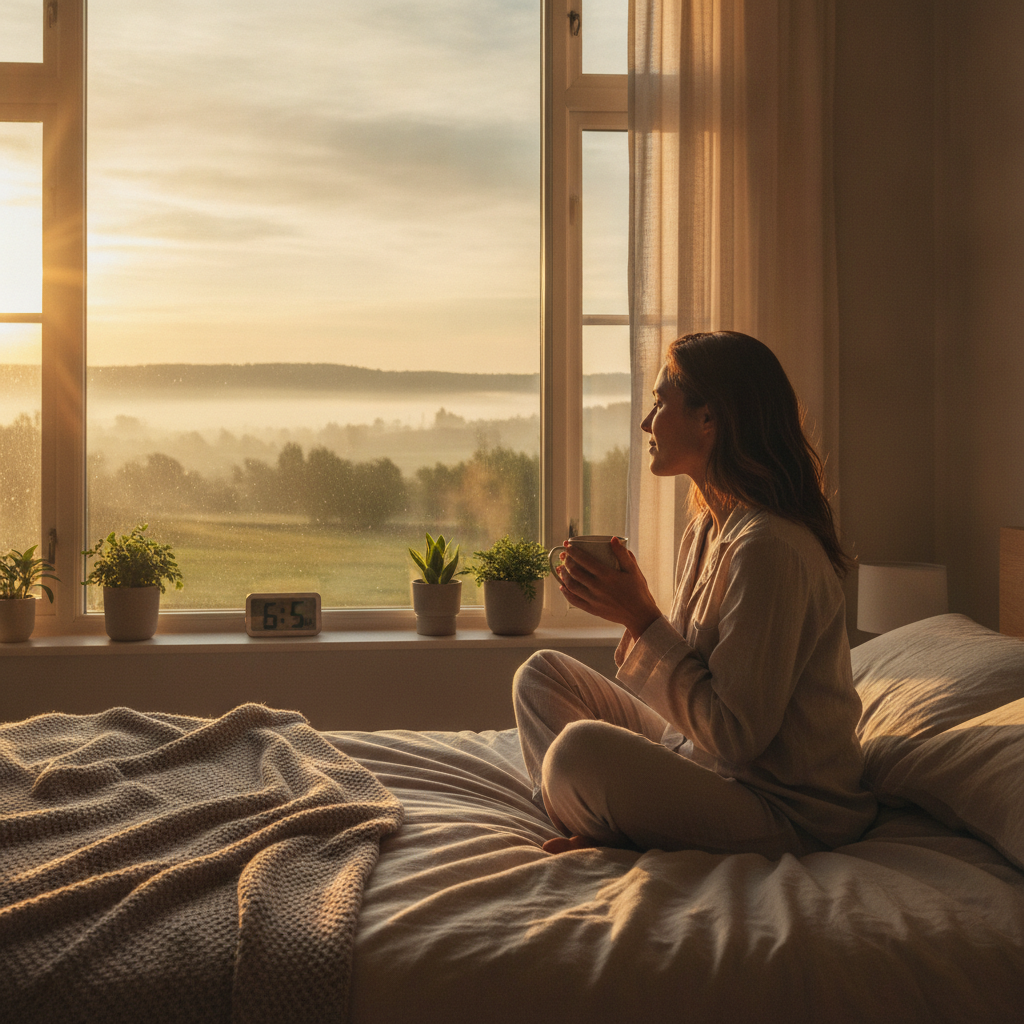
Waiting two or three hours before going outside still offers some benefit, but the response is noticeably weaker. The calibration window narrows as the morning progresses. Even fifteen to twenty minutes of outdoor exposure during that first hour — sitting on a porch, walking to a coffee shop, or standing in a garden — is enough to produce a meaningful effect. You don't need direct sunlight on your skin; what matters is light entering your eyes in an outdoor environment.
What Changes by Bedtime
The Evening Payoff of a Morning Habit
When your circadian clock receives a strong morning anchor, the timing of your melatonin release in the evening becomes more predictable and more robust. Melatonin doesn't just help you fall asleep — it signals your body to drop its core temperature, shift into cellular repair mode, and transition into deeper sleep stages. A well-anchored rhythm means that signal arrives on time, at the right intensity, without the delayed or blunted release that often accompanies irregular light exposure.
People who consistently get morning outdoor light tend to fall asleep faster, spend more time in restorative deep sleep, and wake up feeling less groggy. The effect compounds over days and weeks. A single morning outside won't transform your sleep overnight, but a consistent habit — especially across seasons when natural light timing shifts — builds a rhythm your body can rely on.
Making It a Seasonal Practice
Adjusting Your Approach Through the Year
Morning light habits are especially worth establishing — or revisiting — at seasonal transitions. In spring and summer, outdoor light is abundant and easy to access; even a brief walk before work delivers a strong circadian signal. Autumn and winter require more intention. Days are shorter, and the light that arrives in the early morning is softer and lower in intensity, which means you may need to extend your time outside slightly to get the same calibrating effect.
Apps like **Rise Sleep** and **Oura** track your circadian rhythm and sleep debt in real time, making it easier to see how your morning habits are actually influencing your nights. **Rise Sleep** specifically models your predicted energy levels and sleep pressure across the day, so you can observe directly what happens on mornings when you do go outside early versus mornings when you don't. **Oura Ring** users often notice improvements in their readiness and deep sleep scores within a week of adding consistent morning light exposure. These tools don't replace the habit — but they do make the invisible effects visible, which is often the motivation people need to keep going.
Building the Habit Without Overhauling Your Morning
Small Shifts That Stick
The most effective morning light habit is one that fits naturally into what you're already doing. You don't need to add a dedicated outdoor session to a morning that's already stretched thin. Drinking your coffee outside, walking to pick up a newspaper, or pairing light exposure with a short mindfulness session using an app like **Calm** all count. The key is that you're physically outside, with your eyes open to the sky — not behind glass, which filters out a significant portion of the wavelengths your circadian receptors need.
If your schedule makes outdoor time difficult immediately after waking, a light therapy lamp like those from **Carex** or **Verilux** can offer partial support on particularly constrained mornings — but treat it as a backup, not a replacement. Natural outdoor light remains significantly more effective. Even on overcast days, outdoor light intensity is multiple times higher than indoor lighting, making a cloudy morning outside still worth stepping into.
A Simple Starting Point
Building a sleep-supporting morning light habit doesn't require a major lifestyle overhaul. It starts with recognizing that sleep quality isn't determined only by what you do before bed — it's shaped by the signals your body receives from the moment you wake up. Spending a few deliberate minutes outside each morning, especially in the first hour after rising, is one of the most practical, low-effort adjustments you can make to support longer-term sleep health. As the season shifts and mornings grow brighter, this is a natural time to step outside and let your body recalibrate. Start with one morning this week and notice how the evening feels.