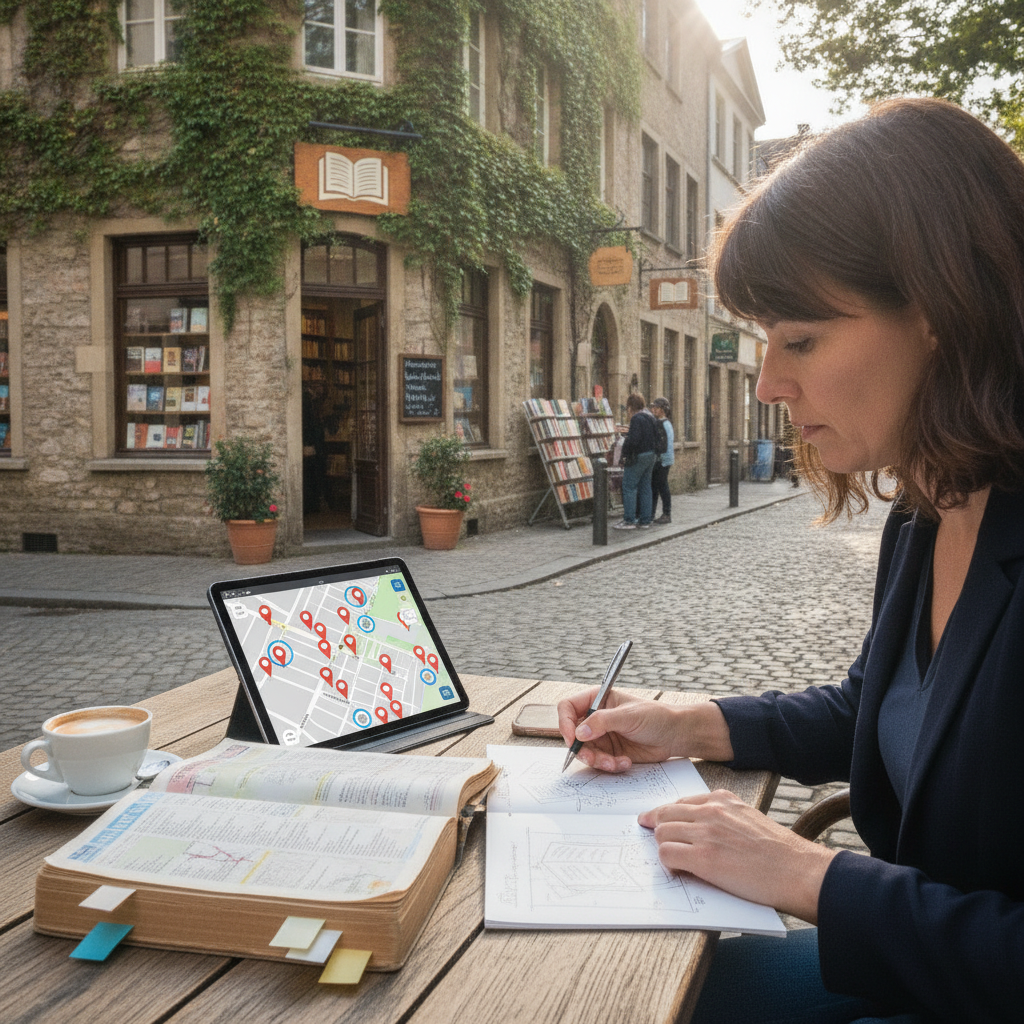
Every city tells a different story about what it values, and few objects carry those values more honestly than a bookshelf. The books a community chooses to stock, sell, and celebrate in its independent shops — arranged not by algorithm but by human instinct — offer a kind of cultural X-ray that no official tourism narrative can replicate. Before a traveler ever lands, the simple act of mapping a destination's independent bookshops creates a framework that is simultaneously practical and revelatory.
Why Bookshops Function as Cultural Mirrors
An independent bookshop is, by definition, a reflection of its owner's taste filtered through community demand. Unlike chain retailers constrained by centralized buying, these shops stock what sells locally, what the owner believes in, and what the neighborhood's readers return for. A shop in Lisbon's Mouraria district will look nothing like one tucked into Melbourne's Fitzroy, and that difference is the entire point. The selection, the physical arrangement, the languages represented, and even the proportion of translated foreign literature versus domestic writing all speak to how a community positions itself relative to the wider world.
Reading the Shelves as a Map of Local Identity
When a traveler researches independent bookshops before departure — using tools like the Bookshop.org store locator, AbeBooks' independent seller listings, or simply searching a neighborhood name alongside the word 'librería' or 'librairie' — patterns begin to emerge quickly. A city with a dense cluster of politically themed shops, or one where cooking and craft dominate the shelves, is signaling something about its civic personality. The French concept of *littérature engagée* — literature understood as a form of social commitment — appears physically in the shelves of shops in cities where intellectual life and political life have historically overlapped. Spotting that kind of emphasis before arrival primes a traveler to notice it everywhere else.
The Neighborhood Placement Tells Its Own Story
Where a bookshop sits within a city is almost as informative as what it stocks. Independent bookshops tend to cluster in neighborhoods that still value foot traffic, conversation, and the kind of slow commerce that resists online competition. These are rarely the neighborhoods dominated by luxury retail or tourist-facing gift shops. Mapping their locations — before arriving — effectively generates a rough outline of where a city's creative and intellectual life is concentrated. Shakespeare and Company in Paris is the obvious example, but the more useful research involves finding the less-famous equivalents: the multilingual shop in a migrant neighborhood, the radical political bookshop sharing a block with a community garden, or the antiquarian dealer whose window hasn't changed in decades.
What the Language Mix Reveals About Community
One of the most underused signals in a bookshop is its language mix — particularly in cities with significant immigrant populations or contested colonial histories. A shop that prominently features indigenous-language texts alongside the dominant national language is making a cultural statement that visitor centers rarely articulate directly. In cities like Barcelona, the proportion of Catalan to Castilian titles in a given shop communicates something about the political orientation of that block, almost as reliably as any neighborhood demographic data. Travelers who notice this before arrival — by looking at shop websites, social media, or even Google Street View — arrive already attuned to a layer of local life that most guidebooks flatten into a single paragraph.
How the Research Process Itself Shapes the Trip
The act of mapping bookshops before a trip is not purely logistical. It functions as a form of *slow travel preparation* — a French-influenced approach to tourism that values depth of engagement over breadth of sights. Working through shop websites, reading their 'about' pages, and occasionally scrolling their event calendars means arriving with a mental map of local intellectual life: who's giving readings, what topics are generating community interest, which authors are treated as local heroes. This kind of research tends to generate questions that stay with a traveler throughout the trip, making observations more layered and connections more memorable than any curated walking tour could produce.
Turning the Map Into a Practical Itinerary
Once a traveler has identified five to eight independent bookshops across a destination, clustering them geographically naturally generates a walking itinerary that passes through the city's most textured neighborhoods. Apps like Google Maps' custom list feature or the itinerary builder in Lonely Planet's digital tools make this straightforward. The result is rarely a direct path between famous sights — it tends instead to thread through quieter streets, local cafés, and the kinds of blocks that reward curiosity over efficiency. Each shop becomes an anchor point for a longer wander, and collectively they create a day's worth of genuine encounter with local life rather than its tourist-facing surface.
What You Carry Home That Doesn't Fit in a Bag
The paradox of using bookshops as a cultural framework is that the most valuable thing a traveler gains from this approach isn't a book — it's a sensibility. By the end of a trip shaped partly around independent shops, a traveler tends to have spoken with more locals than they would have otherwise, noticed more neighborhood texture, and developed a more nuanced sense of what actually animates the place. That sensibility doesn't expire when the flight home departs. Just as the opening observation holds — that a city reveals itself through what it chooses to put on a shelf — so too does a traveler reveal something about their own curiosity by choosing to look there first. The most honest portraits of a place are rarely painted in its museums. They're shelved quietly between a translated novel and a local poet, in a shop most visitors never find.