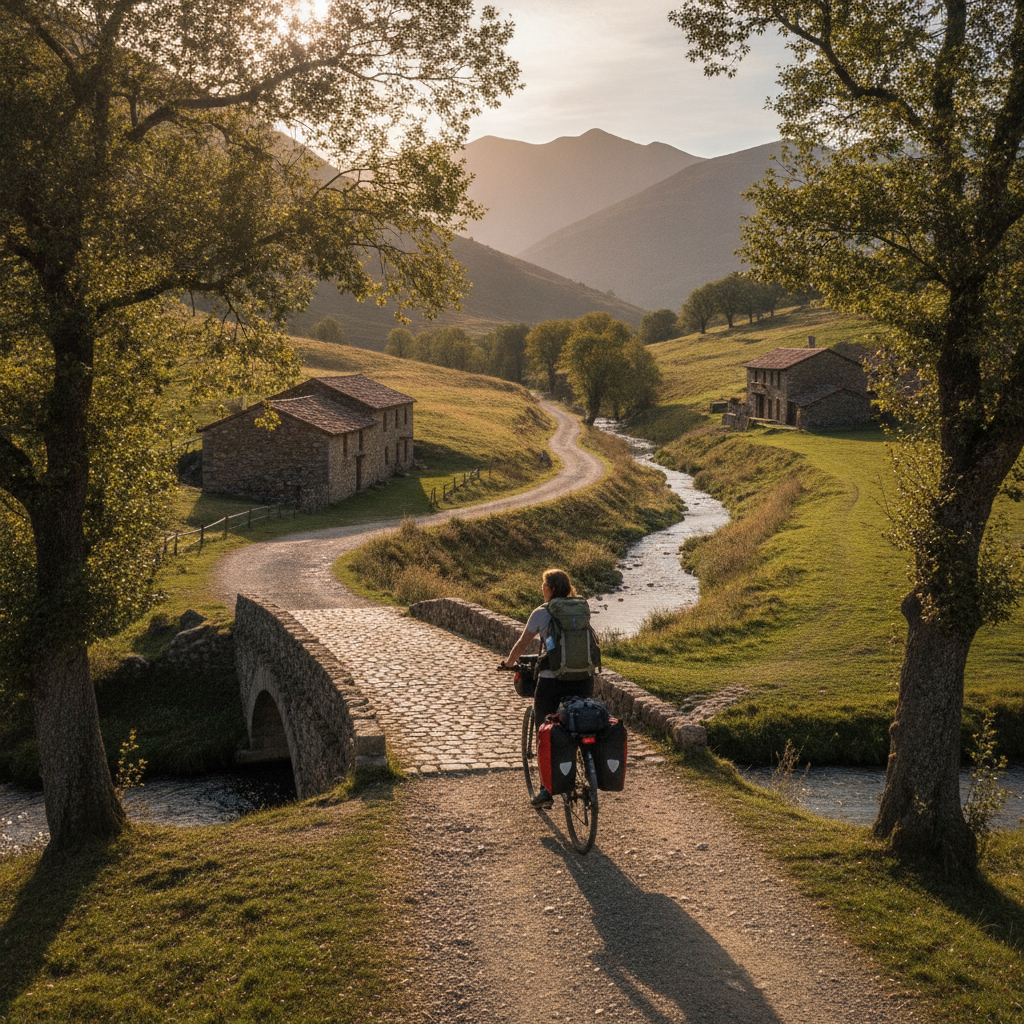
Travel organized around a list of attractions has a particular quality to it — a restlessness, a sense of perpetually arriving somewhere new just as the previous place was beginning to feel real. The hours blur together in transit, the places accumulate without quite connecting, and the traveler returns home with photographs but sometimes struggles to build a coherent narrative from them. This is not a failure of effort or enthusiasm. It is simply what happens when a trip is structured as a series of endpoints rather than as a continuous arc.
The Architecture of a Route-Led Journey
A long-distance walking or cycling route does something fundamentally different to the architecture of a trip. It imposes a direction, a daily logic, and a physical continuity that no itinerary of sites can replicate. Routes like the Camino de Santiago across northern Spain, the Loire à Vélo in France, or the Coast to Coast path in northern England were not designed primarily as tourism products — they evolved as pilgrimage corridors, trade paths, and river roads, and that origin gives them a coherence that a curated highlight reel cannot manufacture. When a traveler commits to one of these routes as the central structure of a trip, every decision that follows — where to sleep, where to eat, how far to go — derives naturally from the logic of the path itself. The cognitive load of constant itinerary management dissolves, replaced by a simpler, more satisfying daily question: how far can I go today, and what will I find when I stop?
The experience of moving through a landscape at the speed of a bicycle or a pair of boots is qualitatively different from passing through it by train or car. At walking pace, the transition between one village and the next is gradual and earned. The traveler notices the shift from vineyard to wheat field, from limestone to granite, from the accent of one valley to the dialect of the next. This phenomenon — what cultural geographers sometimes call *paysage*, the French term for the layered, human-shaped landscape — becomes readable in a way that is simply impossible from a window seat. The route does not just connect places; it reveals the tissue between them.
How Linear Progress Shapes Memory
There is a well-established relationship between physical movement and the consolidation of memory, and long-distance travel on foot or by bike exploits this in ways that conventional tourism rarely does. Each day on a route has a beginning, a middle, and an end. There is often a high point — a pass, a ridge, a particularly good café in a village nobody else stopped in — and that structure lends itself to the kind of episodic memory that makes a trip feel rich rather than merely busy. By contrast, a trip organized as a list of attractions tends to produce memories that compete with one another, where the third castle and the fourth cathedral begin to blur regardless of how objectively impressive each one was. The route-led journey generates a personal topography: day four was the day the rain came in over the Meseta, day seven was when the bike tire gave out on a gravel descent outside Blois. These anchors are sticky in a way that "Tuesday: Louvre, Wednesday: Versailles" rarely is.
This narrative quality is not accidental. Long-distance routes were, historically, the primary way that ordinary people moved through the world, and the stories that accumulated along them — the legends, the place names, the patron saints of particular crossings — reflect centuries of that movement. Walking the GR65 in southwestern France, a traveler is sharing a corridor with medieval pilgrims, early modern merchants, and last year's retired accountant from Lyon. That layering of use gives the path a cultural depth that a visit to even the most celebrated monument cannot replicate in isolation.
Simplicity as a Form of Depth
One of the quiet virtues of organizing a trip around a route is the way it simplifies the decision-making surface without reducing the richness of the experience. An attraction-based itinerary requires constant negotiation: which museum, which neighborhood, which restaurant, which day trip. The route-led journey narrows those choices dramatically. There is a path. One follows it, or one doesn't. Within that constraint, the traveler's attention is freed to notice the world rather than manage access to it. The *albergue* culture of the Camino — communal pilgrim hostels where strangers share dormitories and dinner tables — is a direct product of this simplicity. Stripped of the usual apparatus of tourism, travelers find themselves in actual conversation with one another, which is a rarer experience than it sounds.
This is where you begin to feel the deeper payoff of the route as frame. When the day's only obligation is to keep moving in roughly the right direction, incidental encounters stop feeling like interruptions and start feeling like the point. The olive farmer who waves you off the road to show you a spring. The cyclist from Düsseldorf who has been on the Loire à Vélo for eleven days and knows which boulangeries open before seven. The abbey that does not appear in any guidebook because it sits three kilometers off the main tourist road but is directly on the walking path. These are not things you can schedule. They arrive because the route has put you in the right place at the right pace, which is precisely what an itinerary of attractions, however well researched, cannot do on your behalf.
Travel has always been, at its best, less about the accumulation of sights than about the quality of attention one brings to moving through the world. The long-distance route is simply a very effective technology for protecting that attention — giving it a direction, a rhythm, and enough daily simplicity that the world has room to surprise you. The traveler who returns from a week on the Via Francigena or the Danube Cycle Path does not come back with a checklist. They come back with a story that has a beginning, a middle, and an end, and that story, unlike so many carefully planned itineraries, holds together completely.