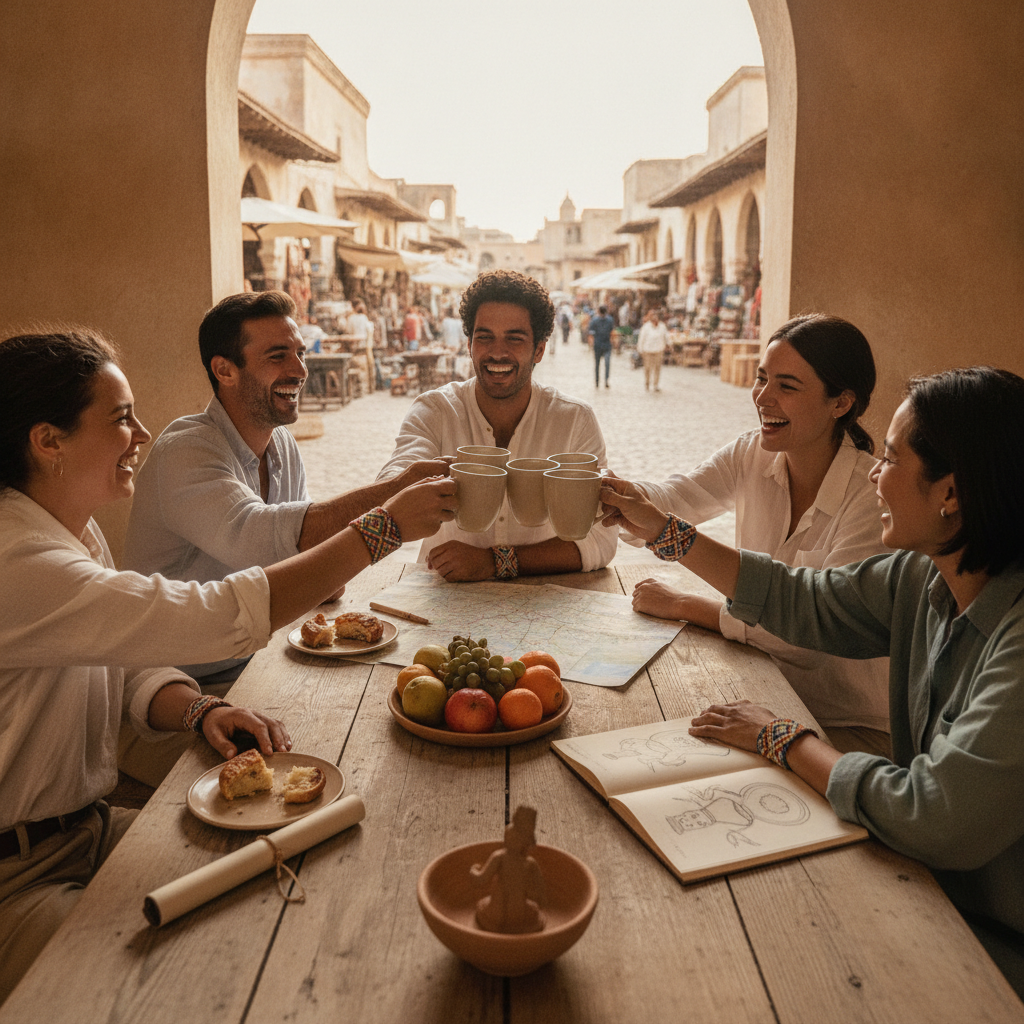
There is a particular kind of loneliness that arrives not in isolation but in the middle of a crowd — the feeling of moving through a beautiful place without belonging to any of it. Travelers know it well. They photograph the piazza, eat the recommended pasta, check off the cathedral, and still return to their room with the faint sense that the city held something back. What most itineraries miss isn't another landmark. It's rhythm. The kind of rhythm that residents live inside every week, without thinking about it, because it anchors them to each other.
The Architecture of Belonging
Community, in any culture, is rarely built through grand gestures. It accumulates through repetition — the same faces at the same time, week after week, until familiarity shades into warmth. Anthropologists who study social cohesion use the term *third place* to describe the gathering spaces that exist outside home and work: the corner café in Lisbon's Mouraria district, the Sunday mercado in Oaxaca, the Saturday parkrun along London's Waterlow Park. These aren't tourist attractions, even when tourists occasionally wander through them. They are the connective tissue of neighborhood life, and they operate on a frequency that a single visit cannot tune into. The traveler who shows up once sees a pleasant scene. The one who returns the following week becomes, briefly, a known quantity.
This distinction matters more than it might appear. Recognition — being seen and acknowledged by someone who has no professional obligation to do so — produces a social warmth that no hotel concierge or tour guide can replicate. It is the difference between being a guest and being a temporary resident, and it shapes not just how a traveler feels but what they are able to access. Conversations open differently when someone remembers your face. Recommendations become more specific, more generous, more honest.
What Repetition Unlocks That Single Visits Cannot
The mechanics of connection follow a predictable pattern, one that most travelers inadvertently bypass by treating every day as a new beginning. A first appearance at any recurring gathering — a Wednesday morning run club in Melbourne's Fitzroy, a weekend farmers' market in Portland's Alberta Arts District — is essentially an audition. People assess newcomers with the relaxed curiosity of those who have nothing to prove. A second appearance changes the dynamic entirely. It signals intent. It says, without words, that the traveler isn't simply consuming a moment but choosing to participate in a structure that exists independent of their presence.
By the third visit, something subtler shifts. Names get exchanged. Questions become more personal. The kind of slow, unperformed conversation that guidebooks cannot manufacture begins to emerge. This is the zone where real local knowledge lives — not the curated version offered to strangers, but the kind shared between people who share a routine. A runner who has seen you twice on the same route will tell you about the bakery that opens at six, the shortcut through the park, the neighborhood bar where the owner pours generously on weeknights. That information travels through trust, not tourism.
The Right Kind of Activity to Look For
Not every recurring event creates equal conditions for connection. The most productive ones tend to share a few qualities: they are low-stakes, they involve some degree of side-by-side participation rather than face-to-face performance, and they attract a stable core of regulars rather than an entirely rotating audience. Run clubs fit this profile almost perfectly. So do community yoga sessions in public parks, open-water swimming groups, weekend language exchange meetups, and the informal networks that form around weekly outdoor markets in cities from Bologna to Bangkok.
Markets deserve particular attention as a connection point because they combine commerce, ritual, and social display in a way that naturally slows people down. The concept of *mercado* culture, common across Latin America and Southern Europe, treats the weekly market as something closer to a civic event than a shopping errand. Vendors recognize their regulars; regulars bring neighbors; neighbors introduce strangers. A traveler who visits the same market stand twice in a single trip — buying tomatoes on Saturday, returning for cheese on the following Wednesday — will almost always find that the second exchange carries a different warmth than the first. The vendor remembers. Small as that sounds, it is not small.
Why These Connections Tend to Last
The relationships formed through shared routine have a structural advantage over those made through shared adventure. Adventure-based travel friendships — the hostel bonding, the tour-bus camaraderie — are intense but contextual. They depend on the specific conditions of their creation and often fade when those conditions dissolve. Routine-based connections are quieter but more durable because they are rooted in something that continues after the traveler leaves. The run club keeps running. The market keeps opening. The regulars keep showing up.
This continuity creates a kind of ongoing anchor. Travelers who participate in recurring local activities often find themselves maintaining contact with people they met not through dramatic shared experience but through the simple fact of showing up more than once. A message months later — *I tried that bakery you mentioned, it was exactly right* — lands differently than a message sent to a hostel acquaintance. It references a shared texture rather than a shared event, and that texture persists because it belongs to a place, not just a moment.
Returning to the Feeling That Started the Journey
When you spend the second Sunday at the same market, or lace up for the same run club two Tuesdays in a row, something in the trip reorganizes itself. The city stops being a sequence of experiences and starts feeling, faintly but genuinely, like somewhere you know. The loneliness that hovers at the edge of even the most beautiful travel — the sense of being a spectator in someone else's life — begins to recede. What replaces it isn't quite belonging, but it is its honest approximation: the recognition that you chose to show up again, and that the place, in its quiet way, noticed.