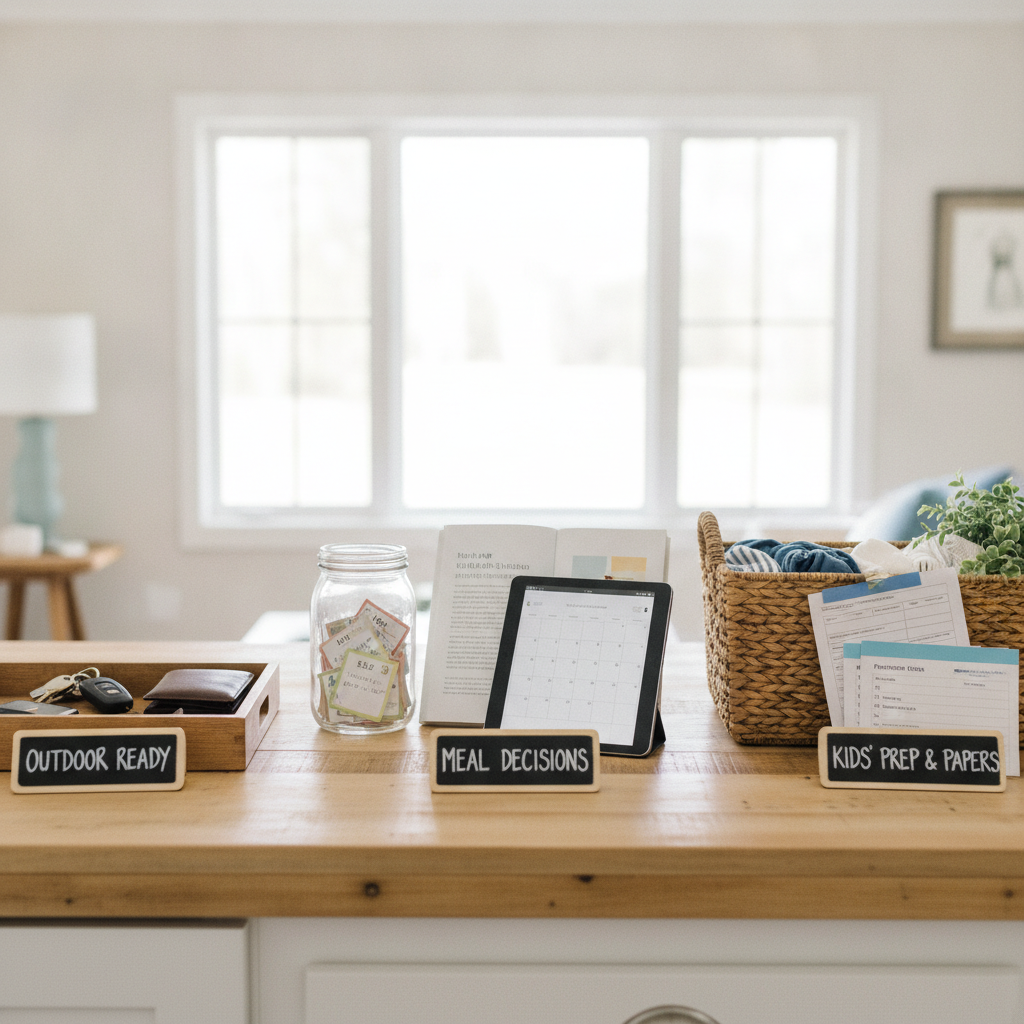
Running a home involves hundreds of small decisions that repeat themselves week after week — where to put the permission slip, who handles the utility bill, what happens when the pantry runs low. None of these tasks is particularly hard on its own, but the accumulation of having to decide where they happen, and when, and by whom, creates a quiet, persistent drain on mental energy. The problem isn't the tasks. It's the absence of a fixed home for each recurring decision. When you give those decisions a physical anchor, the cognitive overhead drops significantly.
Create a Dedicated Spot for Outgoing Action Items
Every home generates things that need to leave: packages to return, library books, permission slips, borrowed items. When these objects live in random spots — the kitchen counter, a dining chair, your bedroom floor — you mentally track each one separately, which adds background noise to your day. A single outgoing tray or basket near your front door, like the kind sold at IKEA or The Container Store, consolidates all of it into one location. You stop wondering where things are because the rule is simple: if it's leaving the house, it lives there until it does.
Anchor Your Bill-Paying to One Physical Zone
Financial paperwork tends to scatter — a statement on the desk, a reminder on the fridge, a bill on the counter by the coffee maker. Designating one specific drawer or desktop organizer as the bill and paperwork zone eliminates that scatter entirely. When everything related to household finances lands in one spot, you're not reconstructing context every time you sit down to handle it. Apps like Mint or YNAB handle the digital side well, but physical documents still need a home. Pairing a digital tool with a fixed physical spot closes the loop on both ends.
Set a Fixed Location for the Weekly Meal Planning Process
Meal planning works better when it happens in the same spot every time — not because the location is magical, but because the consistency removes the friction of getting started. Whether that's a clipboard on the pantry door, a notebook kept on the kitchen counter, or a whiteboard mounted near the fridge, the physical anchor signals that this is where the thinking happens. You stop deciding where to plan and start just planning. Over time, you'll find yourself naturally gravitating to that spot with very little prompting.
Give Household Admin a Permanent Command Center
School calendars, maintenance schedules, recurring subscription reminders, and household to-do lists tend to exist in a dozen formats and locations simultaneously. Pulling them into a single command center — a corkboard in a hallway, a wall-mounted organizer in the kitchen, or even a dedicated section of a home office — creates one place where the household's operational information lives. Brands like Pottery Barn and Umbra make wall-mounted systems that work well for this, but a simple corkboard functions just as effectively. The format matters less than the commitment to keeping it in one place.
Place Recurring Maintenance Reminders Where the Task Lives
Filter replacements, cleaning schedules, and appliance maintenance are easy to forget not because you don't care, but because the reminder lives somewhere other than the task itself. A sticky note inside the cabinet below the sink, a small label on the water heater, or a laminated card taped to the back of the vacuum remind you exactly where and when the task applies. This approach removes the need to remember maintenance schedules separately from the objects they relate to. The physical proximity of reminder to task is the system.
Designate One Surface for Items That Need a Decision
Some objects arrive in your home without a clear category — a gift you're unsure about, a piece of mail that needs follow-up, a tool borrowed from a neighbor. Without a designated location, these items drift and multiply on every available surface. Assigning one specific tray or shelf as the holding zone for undecided items gives you a single place to review when you have the mental bandwidth to make a call. It also prevents the slow creep of undecided clutter into every room, which is often what makes a home feel more chaotic than it actually is.
Establish a Fixed Drop Zone for Each Family Member's Recurring Items
In households with multiple people, recurring items — keys, wallets, earbuds, chargers — go missing regularly because everyone's default spot is slightly different every day. Assigning each person a named, fixed location — a hook, a small basket, a shelf section — makes the rule physical and visible rather than remembered. This works particularly well near entryways, where transitions happen. When the location is fixed and labeled, the friction of tracking shared household items shifts from a daily negotiation to a quick glance.
Use Physical Placement to Trigger Recurring Weekly Reviews
A weekly household reset — checking supplies, reviewing the week ahead, handling small deferred tasks — is far easier to maintain when it's anchored to a physical location and an object. Keeping a specific notebook or checklist in one fixed spot, such as the kitchen table on Sunday evenings, trains the habit through context rather than willpower alone. The act of sitting in that spot with that object becomes the cue. Over time, the review happens almost automatically, not because you remembered to do it, but because your environment prompted it.
The mental load of running a home rarely comes from any single responsibility — it comes from the accumulated cost of tracking where everything belongs and when everything happens. Giving recurring decisions a fixed physical home is a low-effort, high-return change that pays off quietly every day. Start with one spot this week, make it the rule, and let the habit build from there.