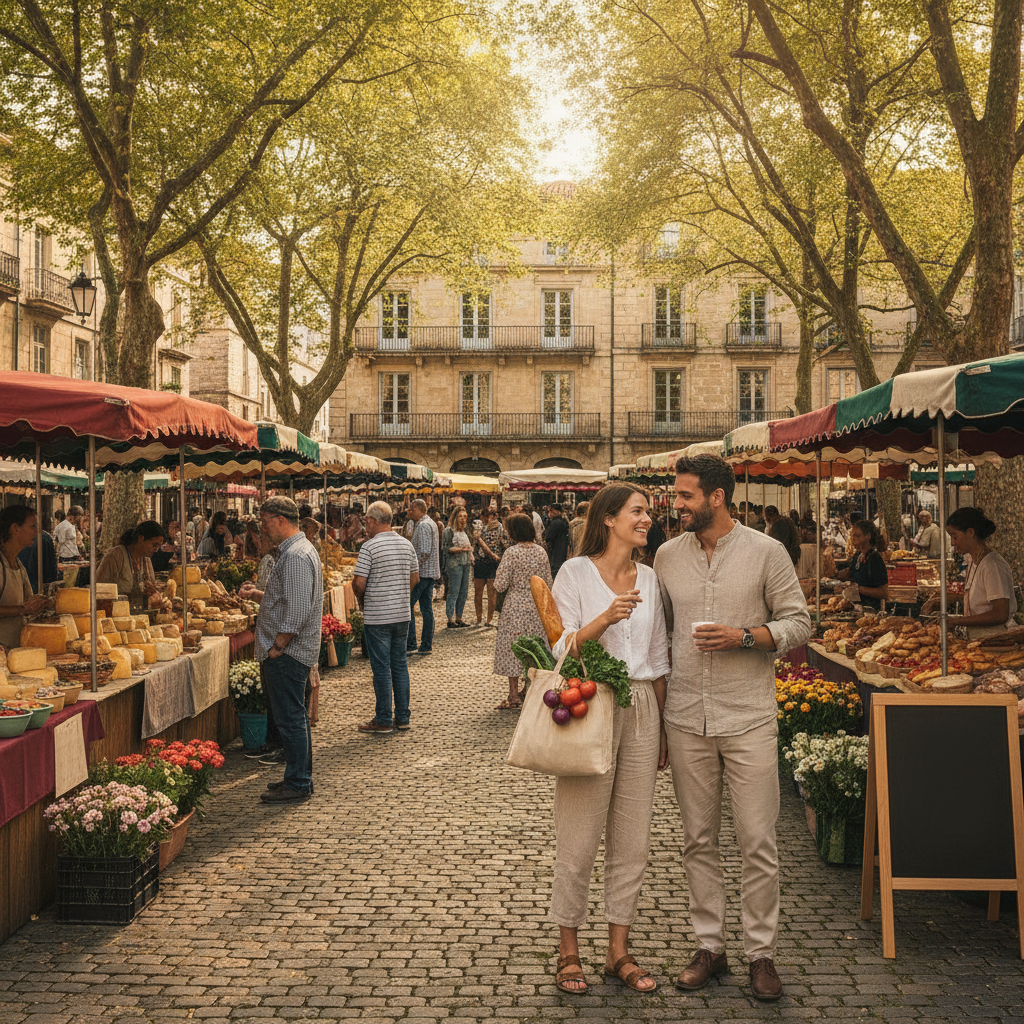
The most reliable way to understand a place is not to visit its most photographed monument but to stand in the middle of its most functional public space and simply pay attention. A neighborhood farmers market — the kind that draws actual residents rather than tour groups, where the vendors know their regulars by name and the stalls reflect what's genuinely in season — offers something no itinerary can manufacture: an unscripted encounter with the rhythms of daily life. When a traveler chooses this kind of market as the fixed point around which a Sunday morning revolves, something unexpected happens. The rest of the week begins to organize itself.
The Market as Social Infrastructure
In many cultures, the weekly market is less a retail event than a form of civic architecture. The French *marché de plein air* (open-air market), the Italian *mercato rionale* (neighborhood market), and the Latin American *tianguis* (indigenous periodic market) all share a structural purpose: they are places where a community performs its collective identity in public. What a traveler sees at a genuine neighborhood market — the produce that appears, the language spoken between stalls, the way vendors and buyers negotiate or joke — is a compressed portrait of local priorities. Barcelona's Mercat de Sant Antoni, for instance, draws a dramatically different crowd than the nearby Boqueria, which long ago shifted toward tourist performance. Choosing the former over the latter is a choice to read the city rather than to be read by it.
The practical consequence of spending a Sunday morning at a market like this is that it generates an enormous amount of raw material for the days that follow. A loaf of bread from a particular baker becomes a reason to find that baker's village of origin on a map. An unfamiliar vegetable becomes a question worth asking a restaurant owner later in the week. A conversation — even a partial one, conducted in broken shared vocabulary — can point toward a neighborhood, a festival, a street worth walking. The market does not just feed a traveler; it seeds an entire week of curiosity.
How Sunday Sets the Week's Orientation
There is a particular kind of traveler who arrives in a new city and immediately begins executing a pre-built schedule — museum at ten, lunch at twelve, monument at three. This approach produces coverage but rarely produces understanding. By contrast, anchoring Sunday morning to a market visit accomplishes something more subtle: it establishes the traveler's orientation as outward rather than inward, toward the life of the place rather than the logistics of tourism. This shift tends to persist through the days that follow.
A Sunday spent at a market also yields practical intelligence that reshapes subsequent planning. The traveler who notices which stalls draw the longest queues has learned something about local taste. The one who watches where residents carry their bags after shopping has been quietly handed a map of the neighborhood's best secondary streets. Portland's PSU Farmers Market, Oaxaca's Mercado Benito Juárez, and Melbourne's Prahran Market each function this way — as orientation devices as much as shopping destinations. The traveler who treats them as such leaves Sunday morning with a mental framework that no app can fully replicate.
The Compound Effect of a Fixed Return Point
One of the underappreciated pleasures of choosing a recurring anchor during travel is the way it creates a sense of accumulated familiarity. A traveler who visits the same market twice — say, on Sunday and again midweek if the market runs on multiple days — experiences the particular satisfaction of recognizing a face, noticing a change in what's available, or being recognized in return. This quality of *returning* rather than perpetually *arriving* changes the emotional texture of a trip. It converts a series of first impressions into something closer to a developing relationship.
Beyond the emotional dimension, a market anchor functions as a reliable logistical hub. It simplifies breakfast and lunch decisions for the days that follow, especially if the traveler picks up bread, cheese, fruit, or cured goods to keep at their accommodation. It reduces the low-grade decision fatigue that accumulates when every meal requires research. And it creates natural pauses in a week that might otherwise become relentlessly scheduled. The market becomes a place to return to, not just a box to check.
What the Market Reveals That Landmarks Cannot
Landmarks are, by design, exceptional. They represent the moments when a culture produced something so significant or unusual that it survived long enough to be protected and signposted. Markets, by contrast, are ordinary — and that ordinariness is precisely what makes them informative. The price of tomatoes, the quality of the cheese, the presence or absence of imported goods, the age distribution of the shoppers, the music playing from a vendor's phone: these details accumulate into an impression of economic life, cultural preference, and generational habit that no monument can convey.
A traveler who spends an hour at Naschmarkt in Vienna on a Saturday morning absorbs something about Austrian urban life that the Kunsthistorisches Museum, for all its magnificence, cannot provide. The same is true of the weekend market at Đồng Xuân in Hanoi, or the Sunday *rastro* (flea and fresh market tradition) that animates certain Madrid neighborhoods. These are not backup attractions; they are primary texts, and the traveler who reads them carefully returns home with a richer account of the place than the one who ticked every landmark on a list.
Building the Rest of the Week Outward
Once the market has been established as a fixed Sunday anchor, the rest of the week builds outward from the intelligence it provides. A cheese vendor mentioned a particular hill town an hour's drive away. A produce stall displayed an herb the traveler had never encountered, which led to a cooking class inquiry at a local cultural center. A brief exchange with another shopper produced a restaurant recommendation that turned out to be the meal of the trip. None of this is guaranteed, but it is the kind of discovery that structured itinerary-following tends to foreclose.
You don't need to speak the language fluently or arrive with extensive local knowledge. What the market rewards is simply the willingness to slow down, to observe before purchasing, and to treat the hour as something other than a transaction. Bring a reusable bag. Accept a sample. Stand still long enough to notice where the light falls at nine in the morning and what the square smells like before the crowds arrive. These small acts of attention are the beginning of a week that will feel, by the end, genuinely inhabited rather than merely visited.
There is a particular quality of memory that travelers return home with when a trip has been organized around lived rhythms rather than landmark checklists — a sense that they were briefly, provisionally, part of the life of a place rather than passing through it. The farmers market, chosen deliberately and visited with patience, is where that quality of experience begins. It is where the week opens, and, looked back upon from the journey's end, it is often where the most lasting impressions were quietly made.