Mental clutter rarely announces itself loudly. It accumulates in small piles — the library book on the kitchen counter, the form that needs signing on the coffee table, the pair of shoes waiting to go back to a friend sitting near the front door. Before long, every room in the house carries the quiet weight of something unfinished, and that ambient pressure follows you from space to space without ever quite resolving.
The solution isn't to finish everything immediately — that's not realistic. The solution is to contain the unfinished. A single, intentional "landing zone" — one designated spot in your home where incomplete tasks live until you're ready to act on them — gives mental loose ends a physical home. When they have a home, they stop colonizing yours.
Choose a Location That's Visible but Not Central
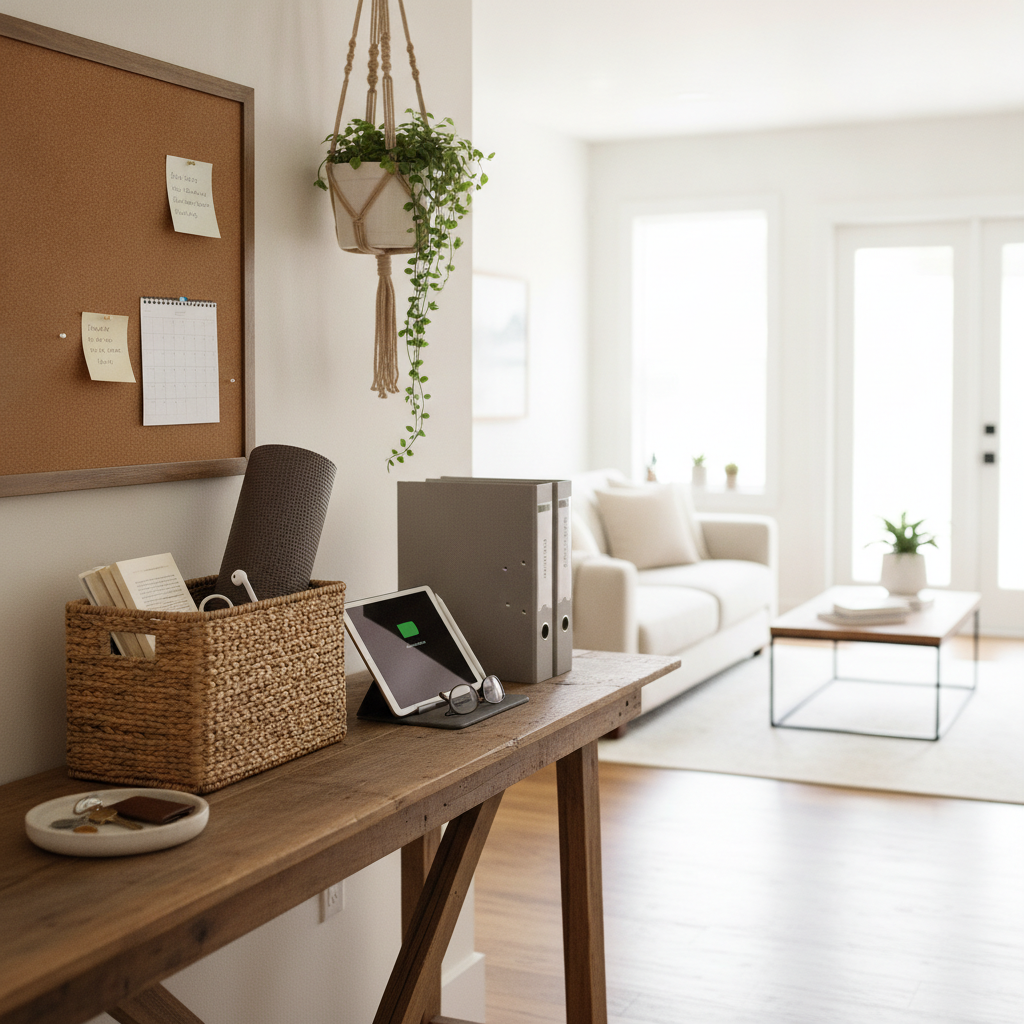
Your landing zone works best when it's accessible without being the first thing you see every time you walk into a room. A small shelf near the entryway, a tray on a side table in the hallway, or a corner of a home office desk all work well. The goal is easy access without constant visual interruption. Placing it somewhere too prominent means it becomes a source of low-grade anxiety rather than relief. Somewhere too hidden and you'll forget to check it, defeating the whole purpose.
Use a Physical Container to Define the Limits
One of the most practical things you can do is make the landing zone a literal container — a basket, a tray, or a small bin. IKEA's KVISSLE letter tray or a simple woven basket from Target both work beautifully. The container matters because it creates a visual boundary. When the tray is full, you know it's time to process — not just add more. This keeps the zone from quietly expanding into a second pile problem, which is the very thing you're trying to avoid.
Set a Weekly Processing Window
A landing zone without a clearing schedule just becomes a slow-moving junk drawer. Block a short, consistent window — twenty to thirty minutes, ideally at the end of the week — to work through whatever has collected. Sunday evenings or Friday afternoons tend to be natural transition points. During this window, you sort, act on, delegate, or discard each item. The regularity is what gives the system its staying power, because your brain starts to trust that things won't get lost.
Keep the Zone Task-Specific, Not General
A landing zone works best when it holds task-related items only — things that need an action attached to them. It's not a general drop zone for keys, mail that's already been handled, or items waiting to be put away. Those belong in different systems. Items that belong in the landing zone include forms to return, items to return to someone, things to research before buying, or notes from a conversation you need to follow up on. Keeping the category tight preserves the clarity of the whole system.
Add a Simple Capture Tool Alongside It
Some unfinished tasks are digital or mental rather than physical — a call you need to return, a task you remembered mid-shower. Pair your physical landing zone with a simple capture tool: a small notepad, a sticky pad, or an app like Todoist or Notion where you drop those intangible loose ends. The idea is the same — one place for things in transit. When both physical and mental items have a home, the feeling of things "floating" noticeably decreases.
Communicate the System to Your Household
If you share your home with a partner, roommates, or family, the landing zone only works if everyone understands what it's for. A quick, low-key conversation goes a long way. Some households use a shared label system — colored sticky notes or a small whiteboard mounted nearby — to indicate whose item is whose and what action it needs. This prevents the zone from becoming a passive-aggressive pile where things disappear or get ignored. A system everyone understands is one everyone actually uses.
Resist the Urge to Create Multiple Zones
The temptation to create a secondary landing zone in the bedroom, or one upstairs "for convenience," is worth resisting. Multiple zones split your attention and erode the whole point of containment. The mental relief that comes from a single landing zone is precisely because your brain learns to look in one place. One zone, consistently maintained, does more for your mental clarity than three half-used zones scattered across different floors.
Review What Lingers and Ask Why
Over time, your landing zone becomes surprisingly revealing. Items that stay there for multiple weeks usually point to something worth examining — a task you're avoiding, a decision you don't have enough information to make, or something that belongs on someone else's plate entirely. A quick honest look at what keeps sitting there helps you catch procrastination patterns before they calcify. The zone isn't just a holding area; it's a low-pressure mirror for how you're actually managing your responsibilities.
Creating a landing zone is a small change with a disproportionate payoff. It won't reorganize your entire home or solve every productivity challenge — but it will stop the slow spread of mental residue from room to room. Start with a single basket, a single shelf, and one consistent weekly check-in. That's genuinely enough to feel a difference.