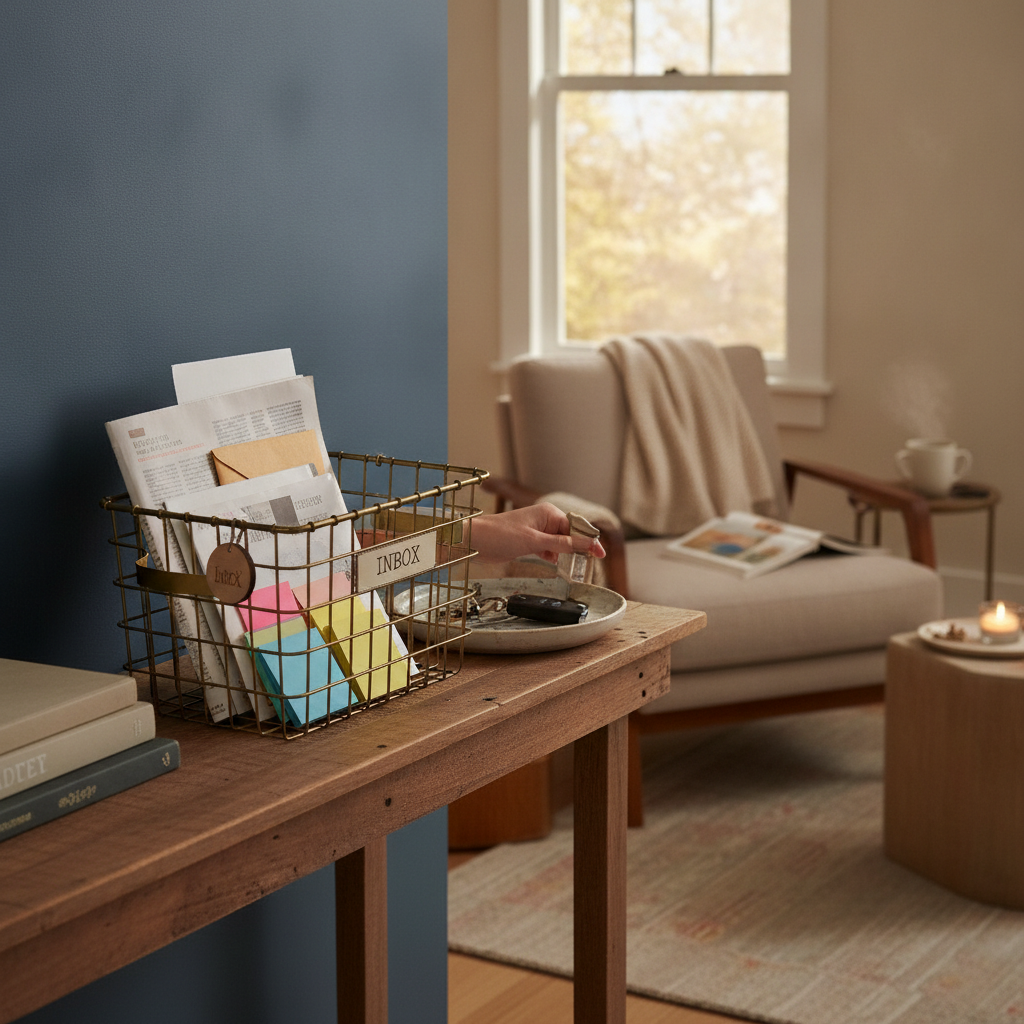
Modern life generates a constant stream of small decisions, and most of them arrive without invitation. A permission slip on the counter, a bill that needs a response, an invitation sitting on the kitchen island — each one quietly competes for your attention before you've even had dinner. Over time, that low-grade pressure accumulates, and by evening, the mental energy you'd hoped to spend on rest or connection is already spent. One surprisingly effective fix doesn't require an app or a productivity system. It's a physical inbox — a single, designated container that holds incoming decisions until you're actually ready to make them.
Choose One Container and Give It a Fixed Home
The inbox itself can be almost anything: a letter tray from an office supply store like Staples, a small basket from IKEA, or even a repurposed wooden box. What matters far more than aesthetics is placement and permanence. Put it somewhere visible but not intrusive — a spot near your entryway or on a corner of your desk where things naturally land anyway. The physical location trains your household to deposit incoming items in one place rather than scattered across every flat surface. Once the container has a home, the habit begins to build itself.
Define What Actually Belongs in the Inbox
Not everything that arrives needs to go in. The inbox is specifically for items that require a decision — not action today, but a choice at some point soon. Think permission slips, RSVPs, utility paperwork, purchase decisions you've been putting off, or printed schedules that require a response. Junk mail, receipts you're keeping for records, and items that have a clear next step right now don't belong. Drawing that boundary early keeps the inbox lean and functional rather than becoming a second junk drawer.
Schedule a Daily Two-Minute Inbox Check
The inbox only works if it has a regular processing moment attached to it. Without one, it fills up and starts generating its own anxiety. A two-minute check each morning — ideally right after coffee, before work demands take over — is enough to stay on top of most incoming items. You're not making every decision in those two minutes. You're sorting: what needs attention today, what can wait until the weekend, and what can be moved immediately to a recycling bin. That brief triage keeps the pile manageable and your evenings clear.
Pair It With a Weekly Decision Window
For items that don't need same-day attention, designate a weekly window — maybe Sunday afternoon or Friday at lunch — where you actually process what's accumulated. This is the moment you sit down with whatever's in the tray and work through it deliberately. You might find an invitation that needs a reply, a service renewal that's been sitting there, or a school form with a deadline approaching. Batching these moments protects the rest of your week from constant low-level interruption. Apps like Todoist or a simple notebook work well alongside this habit to capture any follow-up tasks that surface.
Keep the Inbox Visible but Not Central
There's a balance between accessible and unavoidable. If your inbox sits in the middle of a dining table or right beside the TV, it becomes a passive stressor — a visual reminder of unfinished business when you're trying to decompress. A corner of the entryway, a shelf near the home office door, or a spot on a kitchen counter that isn't the main prep area tends to work well. The goal is that it's easy to drop things in and easy to find when you sit down to process, but it doesn't dominate the room's atmosphere during off-hours.
Create a Simple Overflow Protocol
Some weeks are heavier than others, and the inbox will occasionally fill faster than your processing window can handle. Having a simple overflow rule prevents the system from collapsing under unusual pressure. One approach is a secondary folder or envelope labeled "pending" that lives inside the inbox — a holding area for items you've acknowledged but can't resolve yet. This keeps the main pile from feeling unmanageable and signals to your brain that nothing is being lost or ignored, just queued. That distinction matters more than it sounds.
Use It to Protect Your Partner or Household Members Too
A shared physical inbox works especially well in households where decisions often fall to whoever happens to notice something first. Instead of one person absorbing all the incoming mental load while the other is unaware, the inbox creates a neutral space where both parties can see what's pending. Neighborhoods like shared apartments or busy family homes often develop invisible information asymmetries — one person always in the loop, the other perpetually catching up. A shared inbox levels that out without requiring a meeting or a difficult conversation.
Retire Items That Never Get Processed
Every few weeks, take stock of anything that's been sitting in the inbox for more than two processing cycles without resolution. Chances are, those items either resolved themselves, no longer matter, or represent decisions you're avoiding for a reason worth examining. Removing them — either by acting, discarding, or consciously deferring with a new date — prevents the inbox from becoming a guilt pile. A healthy inbox turns over regularly. Stale items are a signal, not a failure, and clearing them out keeps the whole system feeling light.
Starting small is genuinely enough here. Pick a container you already own, find a spot for it today, and let the habit grow from there. The relief you feel when evenings stop carrying the weight of unprocessed decisions is worth the five minutes it takes to get the system in place.