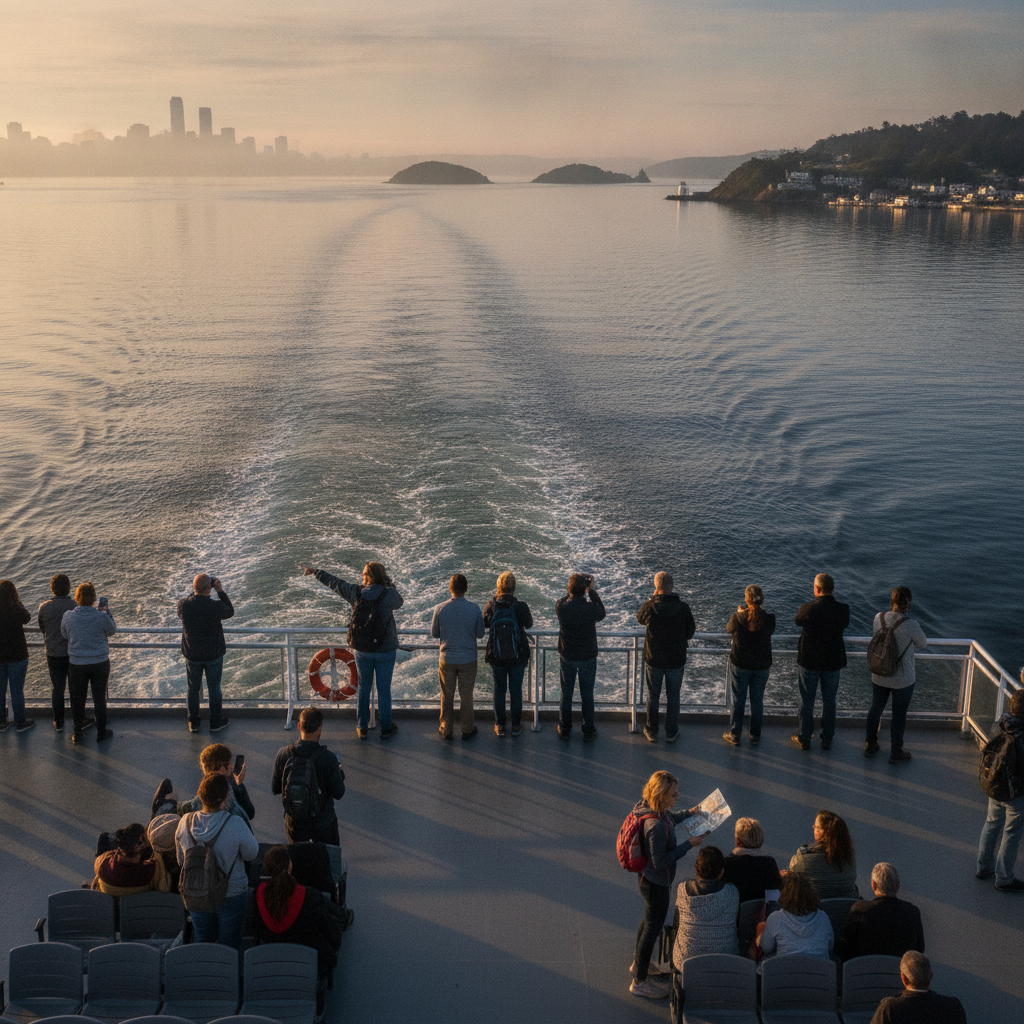
There is a particular kind of seeing that only motion makes possible. A city observed from a fixed point — a hotel window, a museum balcony, a rooftop bar — reveals a version of itself curated for exactly that angle. But a city seen from the water, at the pace of its own working day, from a vessel that belongs to no tourist itinerary, offers something closer to honesty. The commuter ferry, that quiet workhorse of waterfront cities everywhere, has been carrying locals across bays, rivers, and harbor mouths for generations, and it asks nothing of the traveler except the price of a transit ticket.
The Intelligence Hidden in Local Transit Patterns
Before a trip takes shape in earnest, most travelers consult the obvious sources: aggregated review platforms, photography-heavy travel guides, curated lists of neighborhoods and viewpoints. What these sources rarely offer is a sense of how a city organizes itself around water. In places where a ferry network exists as genuine infrastructure — not a tourist cruise dressed up as public transit — the routes themselves encode local knowledge. The busiest crossing at eight in the morning tells you where the workers live and where the employment centers cluster. The late-afternoon surge on a particular line tells you which neighborhoods hold the schools, the markets, the domestic rhythms. Identifying the most-used commuter route before arrival is a form of cartographic literacy that no glossy guide has space to teach.
In Istanbul, the vapur — the word for the traditional passenger ferry that has crossed the Bosphorus for over a century — carries tens of thousands of commuters daily between the European and Asian sides of the city. Identifying the Kadıköy-to-Eminönü crossing as the most heavily traveled route before arrival does more than clarify geography. It signals that this particular water crossing is a social experience, dense with office workers reading, students with headphones, vendors moving between decks selling tea in curved glass tulip cups. Boarding that ferry as a traveler who already knows its function means arriving without the disorientation of a tourist stumbling onto infrastructure they don't understand. The crossing becomes legible, and legibility opens attention for everything else.
Why the Moving Vantage Point Changes What You Actually See
There is a concept in Japanese aesthetics called *ma* — the meaningful pause or interval between things — that travel writers sometimes invoke when describing the value of transition. The commuter ferry embodies something similar. It is a suspended moment between departure and arrival, carried on water, with a city or harbor visible in its full lateral spread. What a guidebook photograph shows in a single frame, the ferry reveals sequentially: the industrial edge of a working port, the residential terraces climbing a hillside, the skyline shifting as the vessel swings around a breakwater. Sydney's Manly Ferry route, which crosses from Circular Quay to Manly Wharf in roughly thirty minutes, is considered by many who live in the city to offer the finest urban view available anywhere in the harbor — and it costs the same as any other Opal card transit fare.
This moving vantage point does something that static observation cannot: it forces spatial understanding. A traveler who has crossed a body of water from one neighborhood to another now understands the relationship between those places in a way that studying a map cannot fully convey. The distance feels measured in time and water rather than kilometers. The city acquires a gravitational logic — certain areas clearly face toward the water, others turn inward, and the ferry crossing makes that orientation visceral. When that traveler later walks a waterfront promenade or looks out from a hillside café, the orientation is already internalized.
Preparing the Research Before You Arrive
The practical work of identifying the right crossing is straightforward, though it requires sources beyond the usual travel planning stack. City transit authority websites — the kind that publish timetables rather than tours — are the most reliable starting point. Apps like Moovit index public ferry routes alongside buses and trains in cities worldwide and can reveal which lines run at commuting frequencies, a reliable indicator of local dependence. Searching for the name of a city alongside terms like "commuter ferry" or "public ferry schedule" rather than "ferry tour" or "harbor cruise" immediately filters out the tourist product and surfaces the working infrastructure.
Social media, used with some selectivity, can also be useful. Residents of waterfront cities often discuss their commutes with the particular attachment people develop for journeys they make daily. A thread in a neighborhood forum about the Tsurumi-to-Sakuragichō water bus in Yokohama, or a local commuter complaining about delays on the Mersey Ferry between Liverpool and Birkenhead, tells a traveler that this is a route with real human investment behind it — which is exactly the kind of crossing worth finding.
What the Ferry Reveals That No Landmark Can
Landmarks are, by definition, exceptional. They rise above the ordinary texture of a city to signal significance, and that signal is useful — but it is also, in a sense, a redirection away from the ordinary. The commuter ferry carries the ordinary in concentrated form. The woman in professional dress reviewing documents on a tablet. The older man with a folded newspaper who nods at the deck hand by name. The school-age child pressing a forehead against the salt-streaked glass of a lower-deck window. These are not performances for visitors; they are simply Tuesday morning.
Travelers who seek that texture — who want to understand a city as a functioning human system rather than as an arrangement of highlights — find the commuter ferry an unusually efficient entry point. In Hong Kong, the Star Ferry between Tsim Sha Tsui and Central has been making that eight-minute crossing since the 1880s, and it remains, alongside the MTR metro, a genuine piece of daily infrastructure. Riding it at 7:45 in the morning, when the upper deck fills with commuters and the harbor light is still low and gold, is a qualitatively different experience from riding it at midday with a guidebook in hand — even though the vessel, the water, and the skyline are identical.
When you choose to ride the most-used crossing at its most ordinary hour — not the scenic sunset departure, not the weekend recreational run, but the Tuesday-morning commute — something shifts in how the city receives you. You are not standing apart from it, appraising it. You are moving through it at its own pace, in its own direction, carried by the same current that carries everyone else who calls it home. The city seen from that perspective doesn't present itself as a destination. It presents itself as a place — which is, for the thoughtful traveler, a far more valuable thing to encounter.