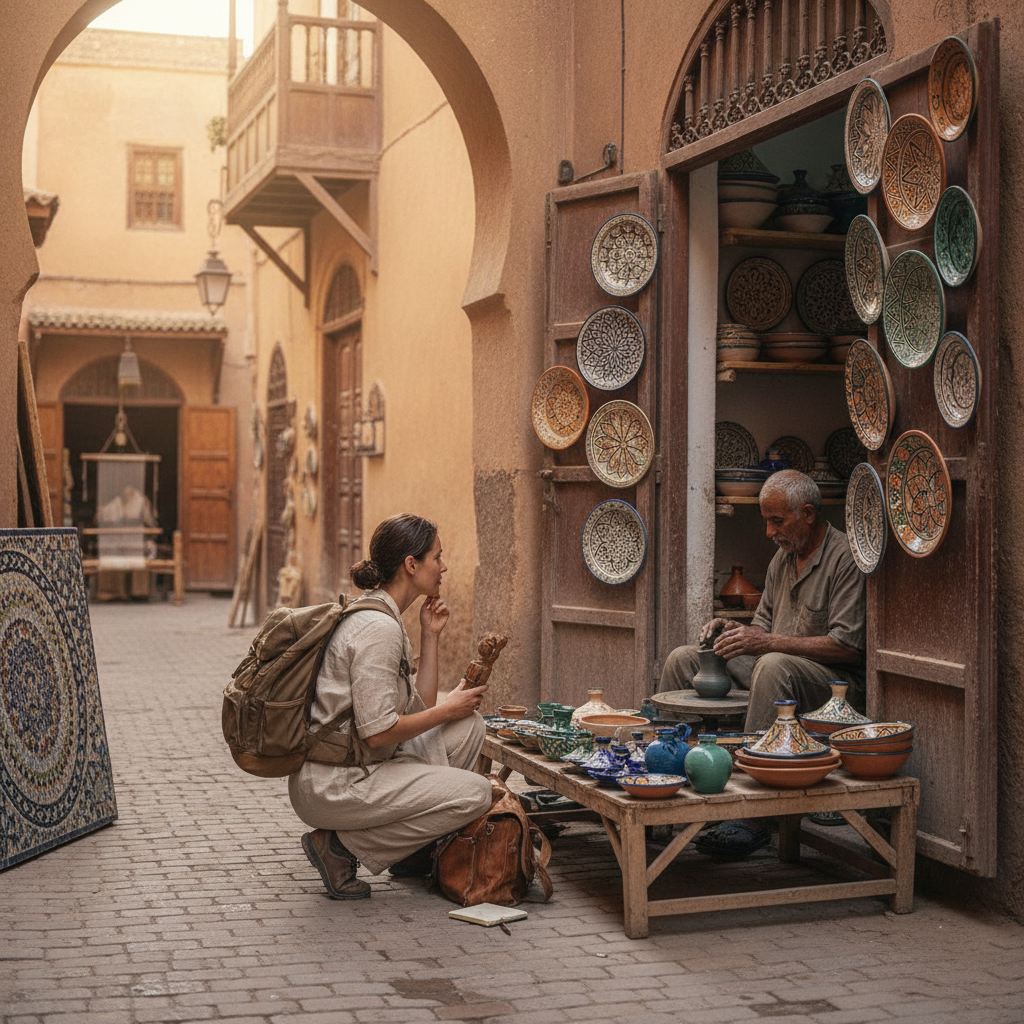
There is a particular kind of travel fatigue that sets in when every city starts to feel like a variation on the same itinerary — the cathedral, the museum, the viewpoint, the guided tour. It isn't that these things lack beauty or meaning. It's that the itinerary itself shapes perception, narrowing what counts as worth seeing and compressing a place into its most photographed edges. When a traveler begins choosing destinations not by monument but by *making* — by the specific materials, tools, and knowledge a community has passed down across generations — something quietly shifts in how the entire trip is experienced.
When the Craft Becomes the Compass
Organizing a journey around a regional artisan tradition does more than add a workshop visit to a standard schedule. It reorients the whole framework of exploration. A traveler going to Oaxaca, Mexico primarily because of its textile weaving traditions isn't just adding a side trip to a backstrap loom demonstration — they're reading the city differently from arrival. The *mercado* (market) becomes a place to understand natural dye sources. The surrounding villages, often overlooked in favor of the colonial center, become essential destinations. The craft tradition functions as a lens that makes visible what a conventional landmarks-first approach would filter out.
This kind of orientation has a useful side effect: it generates genuine curiosity rather than checklist momentum. When the goal is to understand how *taquambaroa* pottery from Michoacán gets its distinctive black finish, or why certain mountain communities in Morocco still produce *zellij* tilework using centuries-old geometric calculations, questions multiply naturally. Each answer leads somewhere new. The traveler stops moving through a place and starts paying attention to it.
The Knowledge You Bring Changes What You Receive
Arriving at a destination with even basic knowledge of its craft tradition changes the quality of every exchange. A visitor in Kyoto who understands the difference between *nishiki* brocade and *kaga-yuzen* hand-dyeing before setting foot in the Nishijin textile district will have a fundamentally different conversation with a local weaver than someone encountering the fabric for the first time in a gift shop. This isn't about performing expertise — it's about coming prepared enough to ask a real question, which is often the only invitation a craftsperson needs to share what they genuinely care about.
That shift — from passive observer to curious participant — tends to make the human encounters on a trip more memorable than any single site. A half-hour conversation in a ceramics workshop in Deruta, Italy, where the tradition of *maiolica* (tin-glazed earthenware decorated with vivid historical motifs) has been practiced since the fifteenth century, can leave a more lasting impression than three hours at a well-trafficked museum. The knowledge exchanged is personal, specific, and unscripted in a way that guided tours rarely manage.
Following the Craft Into Overlooked Places
One of the most practical consequences of craft-centered travel planning is geographic. Artisan traditions rarely survive at their strongest in a country's most-visited city centers. They tend to concentrate in smaller towns, rural villages, and urban neighborhoods that mainstream tourism routes bypass entirely. Choosing a destination this way often means choosing a less crowded version of the region — not as a strategic move to avoid tourists, but as a natural byproduct of following the work to where it actually lives.
A traveler drawn to *molas* — the intricate layered fabric panels sewn by Guna women in Panama — will find themselves in the San Blas archipelago rather than Panama City. Someone interested in *khadi* handspun cotton in India will be pointed toward districts in Gujarat or West Bengal that most international itineraries skip entirely. These places aren't hidden in any mystical sense. They simply require a reason to visit, and the craft provides one.
How the Souvenir Problem Solves Itself
For many travelers, buying something to bring home feels like an obligation that produces regret — the impulse purchase of an object that turns out to have no meaning once unpacked at home. When a trip is organized around artisan craft, this problem largely disappears. The traveler has spent time learning the context, watching the process, and understanding why a particular object is made the way it is. Purchasing directly from a maker isn't a commercial transaction so much as a continuation of the experience.
A piece of *ikat* fabric acquired from a weaver in Uzbekistan, after watching the resist-dyeing process that creates its characteristic blurred pattern, carries a different weight than the same fabric purchased from a boutique abroad. The object becomes a record of the encounter rather than a generic keepsake. Over time, a collection of such objects functions as a kind of material travel journal — each piece traceable to a specific conversation, workshop, or village.
Relearning What a Good Trip Actually Feels Like
The shift this approach produces isn't only logistical. It changes the internal experience of travel itself. When you organize a trip around what a place *makes*, you spend more time with your hands and eyes engaged — watching a potter center clay, tracing the logic of a woven pattern, asking what plant produces a particular shade of indigo. The pace slows not because you've planned less, but because attention itself takes time. Days feel longer in the best sense, more textured and specific.
You also return home differently. Not with the vague sense of having consumed a destination, but with a thread of understanding you can follow after the trip ends — through books, through the objects you've brought back, through a continuing interest in the tradition you barely scratched the surface of. The craft becomes a door that stays open. That quality — the sense that a trip has expanded your world rather than simply occupied a span of days — is what most travelers are actually looking for, even when they don't have a name for it yet.
The fatigue that comes from landmark-to-landmark travel has everything to do with passivity. Choosing a destination because of what its people have spent centuries learning to make is a way of arriving already invested — already asking, already paying attention. Everything that happens from that point forward tends to be more interesting for it.