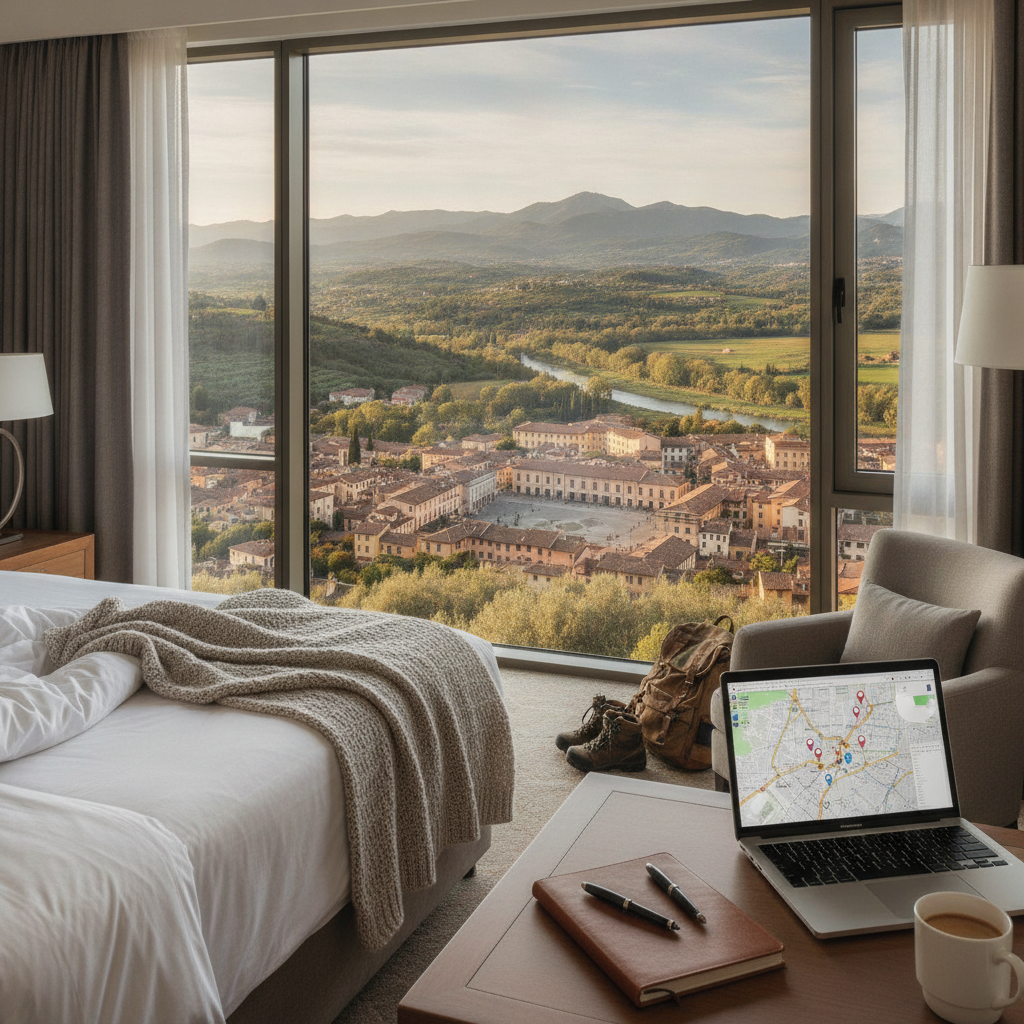
There is a particular kind of exhaustion that belongs only to the traveling kind — the sort that arrives not from walking too many miles, but from packing and unpacking in too many rooms. The traveler who has spent a week moving between four cities knows it well: the mental overhead of checkout times, the vague disorientation of waking up uncertain which country's light is filtering through the curtains, the creeping suspicion that all this movement has somehow produced less understanding, not more. A different approach has been quietly gaining favor among those who travel with intention rather than ambition — the base camp model, in which a single accommodation becomes a home from which a region is explored outward, day by day, at a pace that allows things to actually settle.
The Logic Behind Staying in One Place
The appeal of the multi-city itinerary is easy to understand. It feels productive, even thorough — a checklist of places visited, each one confirmed by a night's stay. But the way people actually absorb a place has little to do with how many places they've slept in. Depth of experience tends to accumulate slowly, through repeated exposure and the small discoveries that only come after the obvious ones are out of the way. A traveler spending five nights in a single town in Umbria will, by the third morning, begin to notice things that the one-night visitor never will: which café fills up with locals at seven in the morning, which street smells of bread before sunrise, which direction the light falls on the cathedral at dusk. The base camp model is, in essence, a bet on depth over breadth.
This approach borrows something from the anthropological concept of *participant observation* — the practice of being present long enough in a place to stop being a stranger to it. When accommodation is fixed, the surrounding area becomes genuinely familiar rather than merely visited. A neighborhood in Porto or a hillside village outside Chiang Mai stops being scenery and starts becoming context. The rhythm of local life — market days, the afternoon quiet, the particular hour when schoolchildren flood a particular street — becomes something a traveler can read rather than simply witness. That shift, from observation to comprehension, is what the base camp model makes possible.
How Day Trips Reshape the Experience of Distance
One of the less obvious advantages of the base camp method is what it does to a traveler's sense of geography. When operating from a fixed point, every day trip becomes a small expedition with a clear return. The distance from a rented apartment in Seville to the whitewashed villages of the Sierra Norte de Sevilla is not just measurable in kilometers — it becomes felt, understood in the body, calibrated against the comfort of a known destination waiting at the end. This is quite different from the experience of moving through places sequentially, where each location must be decoded from scratch and there is no home base pulling you gently back toward familiarity.
Practically, the logistics simplify in ways that free up mental and financial resources. Train tickets, rental cars, and bus routes from a single hub are easier to plan in a repeating pattern than a series of one-way journeys between unfamiliar stations. Apps like Rome2rio and Trainline become tools for daily planning rather than complex itinerary architecture. Luggage stays in one place, which is not a trivial comfort — the physical experience of travel changes when a person isn't managing bags through every transition. What remains is the actual work of exploration, which turns out to be more enjoyable when it isn't tangled up with logistics at every turn.
What Gets Lost in the Constant Movement
The case against multi-city travel isn't that it produces bad experiences — it often produces vivid ones. The issue is more subtle: constant movement tends to privilege the spectacular over the ordinary, and the ordinary is usually where culture lives. The famous landmark is famous because it has been identified and agreed upon; the bakery that three generations of a family have run out of the same narrow storefront is significant in a way that guidebooks rarely register. Travelers who stay long enough in one place begin to encounter both kinds of significance, and to understand how they relate to each other.
There's a Japanese concept worth borrowing here: *ma* (間), which refers to the meaningful pause, the productive space between things. In travel, this translates to unscheduled time — the afternoon with no itinerary, the morning walk taken without a destination. Multi-city travel tends to collapse *ma* out of the schedule entirely, because every moment carries the pressure of making the most of a place before departure. The base camp model, almost by design, restores it. There are more days than there are must-see things, and that surplus of time turns out to be where the most interesting experiences tend to happen.
Choosing the Right Base
The success of the approach depends significantly on where the base camp is placed. A city center apartment in Barcelona offers different access than a farmhouse in the Oaxacan highlands, but both can serve as effective hubs if the surrounding region is rich enough to reward repeated exploration. The ideal base has enough internal life to be interesting on rest days, enough transportation connections to make day trips practical, and enough local character to reward the kind of slow attention the model requires. Platforms like Vrbo and local rental agencies often surface options that traditional hotel searches miss — longer-stay apartments in residential neighborhoods, small guesthouses where the owner doubles as an informal guide to the surrounding area.
When you commit to this way of traveling, something shifts in how you approach a place from the very first day. The pressure to see everything before checkout lifts, replaced by a quieter curiosity about what this particular corner of the world actually looks like when you stop rushing through it. The region begins to feel less like a collection of destinations and more like a single, layered thing — one that reveals itself gradually, the way a good book does, and lingers afterward in the same way.